





 Sign up for our Technology Newsletter

Is NFC Catching On?
January 10, 2013 by admin
Filed under Around The Net
Comments Off on Is NFC Catching On?
Near Field Communication (NFC) is steadily gaining adoption in the U.S. for sharing data and music among smartphones, but the technology faces years of slow growth as a replacement for physical wallets.

NFC will take a minimum of three more years to grab hold as a technology that enables so-called mobile wallets as a replacement for credit cards and cash in the U.S., according to a consensus of five analysts. And by “grab hold,” these analysts mean being used by only 10% of mobile phone users to make digital purchases.
Gartner analyst Avivah Litan predicts that NFC payments will hit the 10% threshold in 2015, compared to the process of SMS (texting) payments that is expected to represent 50% of mobile payment volume globally in that same year. “We’re still on the edge when it comes to NFC innovation,” Litan says. “It will take a decade before it’s mainstream across the globe.”
Dozens of new smartphones that run Android, BlackBerry and Windows, and that include an NFC chip, launched last year. But Apple notably did not put NFC in its new iPhone 5 when the phone launched in September. That move “surely had a significant detrimental impact on industry adoption of NFC,” Litan says, given Apple’s influence in the mobile market.
Apple justified the move by saying that consumers already could use its Passbook app, which shows barcodes on the display, instead of NFC. The barcodes contain information that can be scanned by optical readers to let users board planes and redeem movie tickets — tasks that Apple notes are “the kinds of things consumers need today.”
Some have criticized Apple for omitting NFC from the iPhone 5, which has led to a widespread reassessment of NFC’s immediate future, especially in the U.S.
Was The Prize Stock For 2012?
 If you wanted to know the IT company which was a rotten investment this year, you might be thinking Facebook, HP or RIM.
However according to Business Insider is starting to look like the so-called industry leader, Apple might have caused its investors the biggest headaches. More money has been lost in the past three months in Apple stock than has ever been lost in the tech disasters known as Hewlett-Packard and Research In Motion combined.
HP’s stock price peaked above $50 a few years ago, and now it’s trading at $14 and RIM peaked above $140 a few years ago, and it’s trading for $11. However Jobs Mob’s share price peaked above $700 three months ago and is now trading just above $500. This means that on a percentage basis, therefore, Apple’s stock is down much less than either Hewlett-Packard RIM but has cost shareholders a lot more money.
When HP investors have lost about $100 billion since the 2000 peak and RIM has lost $65 billion since the 2000 peak. Apple has cost its shareholders value in three months. What is more amusing is that about four months ago, I was lectured by an Apple fanboy who told me that the company is going to be worth a trillion dollars by the end of the year and he just invested more than $100,000 in the company. Looks like he would have been better off putting it on a horse.
Toshiba To Offer A 20-megapixel Image Chip
Comments Off on Toshiba To Offer A 20-megapixel Image Chip
 Toshiba is gearing up for to offer a 20-megapixel image sensor for digital cameras that it says will be the highest resolution of its kind.

The Tokyo-based firm said the new chips will be able to support capturing 30 frames per second at full resolution. They will also be able to shoot video at 60 frames per second at 1080P or 100 frames at 720P.
Toshiba said it will begin shipping samples of the new CMOS chips in January, with mass production to begin in August of 300,000 units monthly. Toshiba is best known in components for its NAND flash memory, which it develops with partner SanDisk, but is also a major manufacturer of LSI and other semiconductors.
Digital point-and-shoot cameras are steadily falling in price, squeezed between brutal competition among manufacturers and the increasing threat of smartphones and mobile devices. While the number of pixels a camera can capture is not always a direct measure of the overall quality of its images, it is a key selling point to consumers.
The image resolution of top-end smartphones now often meets or exceed that of digital cameras. The Nokia 808 PureView launched earlier this year has a 41-megapixel image sensor.
The Japanese manufacturer said it has increased the amount of information pixels in the new chip can store compared to its previous generation of CMOS, producing better overall images. It has also reduces the size of pixels – the new 20-megapixel version has individual pixels that measure 1.2 micrometers, down from 1.34 micrometers in its 16-megapixel product.
Toyota Goes Wireless Charging
January 2, 2013 by admin
Filed under Around The Net
Comments Off on Toyota Goes Wireless Charging
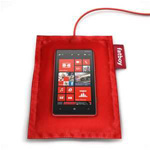 Toyota is taking the smartphone boom quite seriously and the car-maker hopes to offer the first wireless charging systems in select models as early as next year.

Toyota’s wireless system will be compatible with the Qi standard and it will be introduced in the new Avalon sedan next year. Of course, it will be optional and it will be part of Toyota’s $1,950 “technology package” which includes other geeky goodies as well.
According to the BBC, Chrysler is also planning to offer a similar system in the Dodge Dart. Other car-makers will no doubt offer wireless charging functionality sooner rather than later.
The number of Qi compatible phones is limited for the time being. Just 34 phones support it, including the Lumia 920, Nexus 4 and HTC Windows Phone 8X. However, some very popular devices like Apple’s iPhone and Sammy’s Galaxy S series phones don’t support wireless charging just yet.
Google Sells A Piece Of Motorola
December 31, 2012 by admin
Filed under Around The Net
Comments Off on Google Sells A Piece Of Motorola
 Google plans to unload the TV set-top box business of its Motorola Mobility subsidiary to Arris Group, a broadband device vendor, for $2.35 billion.

Arris will also receive patents belonging to the business, called Motorola Home, and will get a perpetual license to other Motorola Mobility patents as part of the deal. The companies announced their agreement late on Wednesday and expect the sale to close by the second quarter of next year.
Google acquired Motorola Mobility in a closely examined deal that concluded in May. It bought the business primarily for its mobile assets and proceeded to seek a buyer for its Motorola Home division, which primarily makes set-top boxes for bringing video and other broadband services to TVs. Motorola Home had revenue of $3.4 billion in the year ending Sept. 30.
Despite the growth of Internet-based video services, Arris sees growth ahead in the set-top box business. The combined companies will have more than 500 customers in 70 countries, according to a press release.
“Every operator that we’ve talked to tells me that in-home devices are not going to go away,” Arris Chairman and CEO Bob Stanzione said on a conference call to discuss the deal. He sees a new generation of the boxes that will carry both traditional and IP (Internet Protocol) video services going into homes soon.
Raspberry Pi Gets A Store
 Raspberry Pi Foundation has opened a store to enable users to easily download applications that run on the credit-card sized computer.
The Raspberry Pi Foundation said it partnered with Indiecity and Velocix to create a store for applications that run on the Raspberry Pi computer. The Foundation said that the store itself is an application that runs under its Raspbian Linux distribution and at launch has 23 applications available for download.
The Raspberry Pi Store contains games such as Freeciv alongside applications such as Libreoffice and Asterisk. The Raspberry Pi Foundation said its store accepts compiled binaries, Python code, images, audio and video.
The Raspberry Pi Store will allow developers to charge for applications, with the Foundation saying that it hopes to see a mix of hobbyist and commercial software. The Foundation also asked users that download applications to review them in order to improve the results put out by its recommendations system.
While the Raspberry Pi was initially intended to help teach people how to program, the device has gained wider popularity due to the fact that its hardware can run many typical PC desktop applications. The Foundation’s Raspberry Pi Store will make it easier for users to find and install applications on the device, which can only be a good thing for the Raspberry Pi Foundation and Linux adoption.
Will Cisco Boot Linksys?
 Cisco reportedly has hired Barclays to find a buyer for its Linksys business.
Cisco bought Linksys back in 2003 to get into the consumer networking business and the firm has put out some good products, most notably the WRT54G wireless router that was a favourite with technology savvy punters. Now Cisco is looking to offload Linksys as it continues to pull back from the consumer networking market.
Cisco has been cutting jobs and products such as the Flip video camera, as it wants to get back to the high margin enterprise networking business. Back in 2003, Cisco paid $500m for Linksys and got access to an established business that focused on producing consumer network equipment.
A decade later, it is being reported that Cisco will be lucky to get its $500m back. Cisco has been pulling out of its failed attempt to get into the consumer market and is now focusing on flogging both network infrastructure hardware and servers, though it is widely expected to be hit hard as software defined networks become more popular.
Unlike Cisco’s core enterprise business, Linksys products typically have low margins, and with its parent firm’s slowing sales growth, it is not surprising Cisco wants to offload it. Bloomberg’s sources said Cisco might find interest in buying Linksys from television makers, though they wouldn’t provide any more details.
Will Lenovo Go Public In 2K14?
 Lenovo’s parent firm Legend Holdings could float an initial public offering (IPO) as soon as 2014, according to the firm’s chairman.
Liu Chuanzhi, chairman of Legend Holdings told China Business News that the firm plans to list on the China A-share market between 2014 and 2016. Chuanzhi also reportedly said the company will invest $3.2bn by 2014 to develop its various businesses.
Legend Holdings is 36 percent owned by the Chinese state controlled Academy of Sciences, with a further 20 percent owned by the private investment firm China Oceanwide Holdings Group.
Legend Holdings also has venture capital and real estate interests outside of Lenovo Group. The firm’s system building operations however have gone from strength to strength since it bought IBM’s PC business back in 2005, and it is now heavily promoting its Yoga tablet-laptop hybrid device.
Earlier this year Gartner reported that Lenovo had overtaken HP to become the largest PC vendor, something that HP disputed by offering IDC’s figures. Regardless of HP’s protestations then, Lenovo is set to overtake HP as its PC business continues to grow while HP’s has been shrinking for some time.
Legend Holdings might want to cash in on Lenovo’s high flying status and a cash injection from an IPO could help the company invest in designing products for the smartphone and tablet markets.
.
Motorola To Close More Locations
December 19, 2012 by admin
Filed under Around The Net
Comments Off on Motorola To Close More Locations
 Motorola Mobility will shut down most operations in South Korea in 2013 as part of an ongoing restructuring under Google ownership.

The decision is estimated to displace about 500 jobs in South Korea and follows a decision made a month ago to close down most international Motorola websites and to lay off about 4,000 workers.
Motorola Mobility said in a statement that it began telling staff in South Korea on Monday about “plans to close most of our operations in Korea, including our research and development and consumer mobile device marketing organization.”
The statement said the changes “reflect our plans to consolidate our global R&D efforts to foster collaboration, and to focus more attention on markets where we are best positioned to compete effectively.”
TSMC To Boost 28nm Production
 TSMC is able to make chips using 28nm process technology at a speedier pace that it originally anticipated. This means that the chipmaker will likely be able to meet demand for existing orders and start accepting new designs.
TSMC promised to increase its 28nm capacity to 68 thousand 300mm wafers per month by the end of the year. It did this by ramping up fab 15/phase 2 to 50,000 300mm wafers a month. According to the Taiwan Economic News it looks like the outfit managed to beat its own projections, which should be good news for customers like AMD, Nvidia and Qualcomm. Well not AMD of course. It just told Globalfoundries to stop making so many of its chips so it can save a bit of money.
But it looks like TSMC is flat out. In November the fab 15/phase 2 processed 52,000 wafers. When combined with fab 15/phase 1, TSMC should be able to process 75 – 80, 000 300mm wafers using 28nm process technologies this month. TSMC produces the majority of 28nm chips at fab 15, which will have capacity of more than 100,000 300mm wafers per month when fully operational.