





 Sign up for our Technology Newsletter

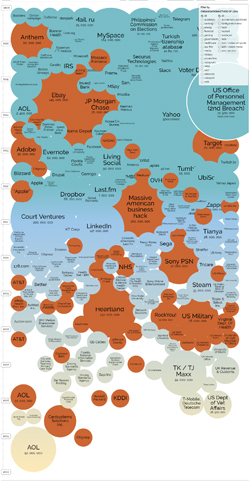
Web.com Latest Hacking Victim
Hackers gain unauthorized access to the computers of Internet services provider Web.com Group and stole credit card information of 93,000 customers.
According to a website set up by the company to share information about the incident, Web.com discovered the security breach on Aug. 13 as part of its ongoing security monitoring.
Attackers compromised credit card information for around 93,000 accounts, as well as the names and addresses associated with them. No other customer information like social security numbers was affected, the company said.
According to the company, the verification codes for the exposed credit cards were not leaked. However, there are websites on the Internet that don’t require such codes for purchases.
Web.com has notified affected customers via email and will also follow up with letters sent through the U.S. Postal Service. Those users can sign up for a one-year free credit monitoring service.
The company did not specify how the intruders gained access to its systems, but has hired a “nationally recognized” IT security firm to conduct an investigation.
Web.com provides a variety of online services, including website and Facebook page design, e-commerce and marketing solutions, domain registration and Web hosting. The company claims to have over 3.3 million customers and owns two other well known Web services companies: Register.com and Network Solutions.
Register.com and Network Solutions customers were not impacted by this breach unless they also purchased services directly from Web.com.
Source-http://www.thegurureview.net/aroundnet-category/web-com-latest-victim-of-credit-card-hacking.html
Dropbox Beefs Up Security
August 25, 2015 by admin
Filed under Around The Net
Comments Off on Dropbox Beefs Up Security
Two-factor authentication is widely regarded as a best practice for security in the online world, but Dropbox has announced a new feature that’s designed to make it even more secure.
Whereas two-step verification most commonly involves the user’s phone for the second authentication method, Dropbox’s new U2F support adds a new means of authenticating the user via Universal 2nd Factor (U2F) security keys instead.
What that means is that users can now use a USB key as an additional means to prove who they are.
“This is a very good advancement and adds extra security over mobile notifications for two-factor authentication,” said Rich Mogull, Securosis CEO.
“Basically, you can’t trick a user into typing in credentials,” Mogull explained. “The attacker has to compromise the exact machine the user is on.”
For most users, phone-based, two-factor authentication is “totally fine,” he said. “But this is a better option in high-security environments and is a good example of where the FIDO standard is headed.”
Security keys provide stronger defense against credential-theft attacks like phishing, Dropbox said.
“Even if you’re using two-step verification with your phone, some sophisticated attackers can still use fake Dropbox websites to lure you into entering your password and verification code,” the company explained in a blog post. “They can then use this information to access your account.”
Security keys, on the other hand, use cryptographic communication and will only work when the user is signing in to the legitimate Dropbox website.
Dropbox users who want to use the new feature will need a security key that follows the FIDO Alliance’s Universal 2nd Factor (U2F) standard. That U2F key can then be set up with the user’s Dropbox account along with any other U2F-enabled services, such as Google.
Has The iPhone Peaked in The U.S.?
August 21, 2015 by admin
Filed under Smartphones
Comments Off on Has The iPhone Peaked in The U.S.?
Apple’s vice like grip in the US smartphone market is falling off as sales of the overpriced gadgets slump.
Research outfit Kantar Worldpanel ComTech said the 2.3 per cent drop in US sales had been covered by rises in China, Japan and Australia.
But the fact that Apple’s home ground is the US and that it has become increasingly dependent on its iPhone, this statistic does not bode well, particularly as the company depends on continual growth to maintain its share price the whole lot is starting become unstuck.
For the second quarter of 2015, iPhone sales grew by 2.1 percent from the same quarter last year across Europe’s five biggest markets, namely the UK, Germany, France, Italy and Spain. Growth was strongest in the UK at 5.5 percent and weakest in Italy at only 0.1 percent. Beyond Europe, iPhone sales surged by 9.1 per cent in Australia, 7.3 percent in China and 2.7 percent in Japan.
It is worthwhile pointing that the European growth outside the UK, Australia and China is more indicative of a flat market rather than actual growth.
A possible reason for the fall in the US is better competition from Android where Apple’s Android rivals provided a tougher fight.
Carolina Milanesi, chief of research at Kantar Worldpanel ComTech, said in a press release. “In the U.S., as we forecasted last month, Android’s growth continued in the quarter ending June 30, with both Samsung and LG increasing their share sequentially. Forty-three percent of all Android buyers mentioned a ‘good deal on the price of the phone’ as the main purchase driver for their new device.”
“Android in the U.S. is undergoing its strongest consolidation yet, with Samsung and LG now accounting for 78 percent of all Android sales,” Milanesi added. “LG is the real success story of the quarter. Not only did it double its share of the US smartphone market once again, but it was also able, for the first time, to acquire more first-time smartphone buyers than Samsung.”
Screen size was the main driver for Android buyers across Europe, according to Dominic Sunnebo, business unit director at Kantar. Samsung and LG both sell big-screen “phablet” phones. Samsung’s Galaxy Note 4 sports a 5.7-inch screen, while LG’s G4 packs in a 5.5-inch screen.
Though the iPhone 6 Plus also uses a 5.5-inch display, iOS buyers are driven by a wider range of factors, Sunnebo said, including “phone reliability and durability, as well as the quality of the materials.”
Of course if you are member of Tame Apple Press you will forget to report the news and say the opposite and claim that the iPhone’s wonderful sales are a problem.
Malware Turns Computers Into Cellular Antenna
Comments Off on Malware Turns Computers Into Cellular Antenna
A team of Israeli researchers have improved on a way to steal data from air-gapped computers, thought to be safer from attack due to their isolation from the Internet.
They’ve figured out how to turn the computer into a cellular transmitter, leaking bits of data that can be picked up by a nearby low-end mobile phone.
While other research has shown it possible to steal data this way, some of those methods required some hardware modifications to the computer. This attack uses ordinary computer hardware to send out the cellular signals.
Their research, which will be featured next week at the 24th USENIX Security Symposium in Washington, D.C., is the first to show it’s possible to steal data using just specialized malware on the computer and the mobile phone.
“If somebody wanted to get access to somebody’s computer at home — let’s say the computer at home wasn’t per se connected to the Internet — you could possibly receive the signal from outside the person’s house,” said Yisroel Mirsky, a doctoral student at Ben-Gurion University and study co-author.
The air-gapped computer that is targeted does need to have a malware program developed by the researchers installed. That could be accomplished by creating a type of worm that infects a machine when a removable drive is connected. It’s believed this method was used to deliver Stuxnet, the malware that sabotaged Iran’s uranium centrifuges.
The malware, called GSMem, acts as a transmitter on an infected computer. It creates specific, memory-related instructions that are transmitted between a computer’s CPU and memory, generating radio waves at GSM, UMTS and LTE frequencies that can be picked up by a nearby mobile device.
The GSMem component that runs on a computer is tiny. “Because our malware has such a small footprint in the memory, it would be very difficult and can easily evade detection,” said Mordechai Guri, also a doctoral student at Ben-Gurion.
HTC To Go High-End
August 18, 2015 by admin
Filed under Smartphones
Comments Off on HTC To Go High-End
Taiwanese smartphone maker HTC Corp said it will eliminate some jobs and discontinue models as part of its strategy to focus on high-end devices to better compete with the likes of AppleInc and Samsung Electronics.

“The cuts will be across the board,” Chief Financial Officer Chialin Chang told reporters after HTC reported a second-quarter loss and forecast another for the third-quarter. “They will be significant.”
Chang said the cost reductions would extend to the first quarter of next year, but declined to give further details.
A pioneer in early smartphones, HTC has been dismissed by industry watchers as confused, unoriginal and uncompetitive.
The company has been losing market share over the past few years, hit by intense competition at the high-end of the market from the likes of Apple and Samsung Electronics while budget Chinese rivals have also eclipsed its low-cost offerings.
HTC shares have fallen 51 percent so far this year. The stock closed 1.69 percent lower before the results were announced.
Chang said HTC was banking on selling high-end models in emerging smartphone markets such as India, where he said the company has a 20 percent market share of phones priced between $250-$400.
Analysts, however, are less optimistic, saying HTC is likely to continue to struggle for the next four quarters at least.
“We believe HTC will keep losing share in the smartphone market and will keep losing money,” analyst Calvin Huang with Taiwan’s SinoPac Securities wrote in a recent research note.
Will Qualcomm Unveil The Snapdragon 820 SoC
Comments Off on Will Qualcomm Unveil The Snapdragon 820 SoC
Qualcomm is set to unveil its new Snapdragon 820 SoC on August 11 in LA and more details are being leaked than you would see at a Welsh leak recipe contest.
It appears that the new Snapdragon 820 will have the catchy title MSM8996 and it promises some significant performance improvements in key areas. We already know that it will not be catching fire, but it also has a 40 per cent GPU performance increase with its A530 GPU.
The device is also claimed to have a 30 per cent power improvement with 64b of shared virtual memory with the CPU.
Another big area of improvement is the Hydra CPU, which claims a 35 percent improvement compared to the Snapdragon 810.
The Snapdragon 820 will support 4k60 entertainment and high-speed data connectivity.
There are rumours that there will be a QFE3100 Envelope Tracking system this will not speed up mail in the criminally slow Italian Post Office, but should create a lower power and a thermal footprint. A dedicated low power sensor is integrated for always on use.
Another major upgrade compared to the older SoC is a switch from 20nm to 14nm FinFET manufacturing process. We are still expecting the Xiaomi Mi5 to be the first one to use it.
Oracle’s New Processor Goes For The Cheap
Comments Off on Oracle’s New Processor Goes For The Cheap
Oracle is looking to expand the market for its Sparc-based servers with a new, low-cost processor which it curiously called Sonoma.
The company isn’t saying yet when the chip will be in the shops but the spec shows that could become a new rival for Intel’s Xeon chips and make Oracle’s servers more competitive.
Sonoma is named after a place where they make cheap terrible Californian wine and Oracle aims the chip at Sparc-based servers at “significantly lower price points” than now.
This means that companies can use them for smaller, less critical applications.
Oracle has not done much with its Sparc line-up for a couple of years, and Sonoma was one of a few new chips planned. The database maker will update its Sparc T5, used in its mid-range systems and the high-end Sparc M7. The technology is expected to filter to the Sonoma lower tier servers.
The Sparc M7 will have technologies for encryption acceleration and memory protection built into the chip. It will include coprocessors to speed up database performance.
According to IDG Sonoma will take those same technologies and bring them down to low-cost points. This means that people can use them in cloud computing and for smaller applications.
He didn’t talk about prices or say how much cheaper the new Sparc systems will be, and it could potentially be years before Sonoma comes to market.
Yahoo Acquires Polyvore
August 12, 2015 by admin
Filed under Around The Net
Comments Off on Yahoo Acquires Polyvore
Yahoo Inc announced on Friday that it has agreed to acquire fashion start-up Polyvore to help drive traffic and strengthen its mobile and social offerings.
Yahoo, which did not disclose terms of the deal, said Polyvore will accelerate its ‘Mavens’ growth strategy.
The company has been focusing on four areas — mobile, video, native advertising and social — which it calls Mavens, to drive user engagement and ad sales as it battles intense competition from Google Inc and Facebook Inc .
Revenue from Mavens made up about one-third of the company’s total revenue in the quarter ended June 30.
The Mavens portfolio includes BrightRoll, mobile app network Flurry, mobile ad buying platform Yahoo Gemini and blogging site Tumblr.
Polyvore, the brainchild of 3 ex-Yahoo engineers, was started in 2007.
The Mountain View, California-based company allows users to mix-and-match articles of clothing and accessories and customize them into “sets”.
Polyvore’s co-founder and CEO Jess Lee was earlier part of Google Inc’s associate manager program, which Marissa Mayer headed before joining Yahoo as CEO.
Is Wafer Output Headed Down?
United Microelectronics (UMC) expects to post an up to 5 per cent decrease in wafer shipments for the third quarter of 2015.
The outfit’s capacity rate will fall below 90 per cent for the first time after being flat out for ages.
UMC CEO Po-Wen Yen said the third quarter, would suffer from the inventory correction problems that were first noticed in the first quarter.
Current weakness in overall demand, partly due to the uncertainties in economic outlook, will prolong the inventory adjustment through the second half of 2015,” he said.
UMC used 94 per cent of its overall capacity in the second quarter of 2015, when the company shipped a record 1.54 million 8-inch equivalent wafers.
Shipments during the quarter were driven mainly by 28nm products, the foundry noted.
UMC reported consolidated revenues of $1.23 billion for the second quarter, down 6 per cent on last year. Gross margin came to 22.9 per cent compared with 24.3 per cent in the first quarter and 22.9 per cent in second.
UMC created net profits of $1.45 billion in the second quarter of 2015 – the highest level in nine quarters.
Looking into the third quarter, UMC expects to use 87-89 per cent of its overall capacity in the third quarter. Wafer shipments and ASPs will fall up to 5 per cent and about 3 per cent, respectively, on quarter.
Can OSX Make Macs Vulnerable To Rootkits?
Comments Off on Can OSX Make Macs Vulnerable To Rootkits?
The software genii at Apple have redesigned their OSX software to allow malware makers to make designer micro-software that can infect Macs with rootkits.
Obviously the feature is one that Apple software experts designed specifically for malware writers, perhaps seeing them as an untapped market.
The bug in the latest version of Apple’s OS X allows attackers root user privileges with a micro code which could be packed into a message.
Security researcher Stefan Esser said that this was the security hole attackers regularly exploit to bypass security protections built into modern operating systems and applications.
The OS X privilege-escalation flaw stems from new error-logging features that Apple added to OS X 10.10. Plainly the software genii did not believe that standard safeguards involving additions to the OS X dynamic linker dyld applied to them because they were protected from harm by Steve Job’s ghost.
This means that attackers to open or create files with root privileges that can reside anywhere in the OS X file system.
“This is obviously a problem, because it allows the creation or opening (for writing) of any file in the filesystem. And because the log file is never closed by dyld and the file is not opened with the close on exec flag the opened file descriptor is inherited by child processes of SUID binaries. This can be easily exploited for privilege-escalation,” Esser said.
The vulnerability is present in both the current 10.10.4 (Yosemite) version of OS X and the current beta version of 10.10.5. Importantly, the current beta version of 10.11 is free of the flaw, an indication that Apple developers may already be aware of the vulnerability.
An Apple spokesman said that engineers are aware of Esser’s post of course they did not say they would do anything about it. They will have to go through the extensional crisis involved in realising that their product was not secure or perfect. Then the security team will have to issue orders, signed in triplicate, sent in, sent back, queried, lost, found, subjected to an internal inquiry, lost again, and finally bury it in soft peat for three months and recycled as firelighters.