





 Sign up for our Technology Newsletter

Is Intel Expanding?
Even if it means that it will be the first to make ARM’s 64-bit chips, Intel said that it wants to expand its contract foundry work. Intel CEO Brian Krzanich said he would expand his company’s small contract manufacturing business, paving the way for more chipmakers to tap into the world’s most advanced process technology.
Krzanich told analysts that he planned to step up the company’s foundry work, effectively giving Intel’s process technology to its rivals. He said that company’s who can use Intel’s leading edge and build computing capabilities that are better than anyone else’s, are good candidates for foundry service. Krzanich added that the slumping personal computer industry, Intel’s core market, was showing signs of bottoming out.
Intel also unveiled two upcoming mobile chips from its Atom line designed interchange features to create different versions of the component. A high-end version of the new chip, code named Broxton, and is due out in mid-2015. SoFIA, a low-end chip was shown as an example of Intel’s pragmatism and willingness to change how it does business. Krzanich said that in the interest of speed, SoFIA would be manufactured outside of Intel, with the goal of bringing it to market next year.
Intel will move production of SoFIA chips to its own 14 nanometer manufacturing lines, Krzanich added.
Researchers Build Flying Robot
December 4, 2013 by admin
Filed under Around The Net
Comments Off on Researchers Build Flying Robot
Researchers say they have assembled a flying robot. It’s not designed to fly like a bird or an insect, but was built to simulate the movements of a swimming jellyfish.

Scientists at New York University say they built the small, flying vehicle to move like the boneless, pulsating, water-dwelling jellyfish.
Leif Ristroph, a post-doctoral student at NYU and a lead researcher on the project, explained that previous flying robots were based on the flight of birds or insects, such as flies.
Last spring, for example, Harvard University researchers announced that they had built an insect-like robot that flies by flapping its wings. The flying robot is so small it has about 1/30th the weight of a U.S. penny.
Before the Harvard work was announced, researchers at the University of Sheffield and the University of Sussex in England worked together to study thebrains of honey bees in an attempt to build an autonomous flying robot.
By creating models of the systems in a bee’s brain that control vision and sense of smell, scientists hope to build a robot that would be able to sense and act as autonomously as a bee.
The problem with those designs, though, is that the flapping wing of a fly is inherently unstable, Ristroph noted.
“To stay in flight and to maneuver, a fly must constantly monitor its environment to sense every gust of wind or approaching predator, adjusting its flying motion to respond within fractions of a second,” Ristroph said. “To recreate that sort of complex control in a mechanical device — and to squeeze it into a small robotic frame — is extremely difficult.”
To get beyond those challenges, Ristroph built a prototype robot that is 8 centimeters wide and weighs two grams. The robot flies by flapping four wings arranged like petals on a flower that pulsate up and down, resembling the flying motion of a moth.
The machine, according to NYU, can hover and fly in a particular direction.
There is more work still to be done. Ristroph reported that his prototype doesn’t have a battery but is attached to an external power source. It also can’t steer, either autonomously or via remote control.
3D Printer Goes Retail
December 3, 2013 by admin
Filed under Around The Net
Comments Off on 3D Printer Goes Retail
MakerBot, a 3D printer maker which opened two new retail stores last week, is among the companies trying to bring the cutting-edge digital manufacturing technology to Main Street consumers, but skeptics say the debut may be premature.

MakerBot, a unit of Stratasys Ltd, opened retail stores this week in Boston and in Greenwich, Connecticut, both of which are twice the size of MakerBot’s first store, 1,500 square feet in downtown Manhattan.
The company offers designs for more than 100,000 items through its “Thingiverse” online user community. The products range from knick-knacks like zombie sculptures to jewelry, sink drains and even medical devices. They are printed using its line of corn-based plastic fibers in more than a dozen colors.
“For most people 3D printing is futuristic science fiction. We’re here to make it real,” said CEO Bre Pettis, who cut the ribbon at the store on Boston’s fashionable Newbury Street using scissors made on one of MakerBot’s Replicator printers which start at $2,199.
Pettis, who has purchased splashy magazine ads to promote 3D printers as holiday gifts, believes there could soon be a 3D printer on every block in America.
Yet some technology experts say 3D printers may not be ready for prime time because they are still much less user friendly than most modern consumer electronics.
“There is so much hype,” said Pete Basiliere, an analyst at technology research firm Gartner. “People are getting a little bit misled as to how easy it is,” he said.
Some investors also are skeptical of 3D printing’s readiness for the market. Short-seller Citron this week published an article questioning the earnings of Germany’s voxeljet AG’s, and shares in the sector fell, including those of MakerBot parent Stratasys and rivals 3D Systems Corp and ExOne Co.
Twitter Tightens Security
Twitter Inc said it has put in place a security technology that makes it harder to spy on its users and called on other Internet firms to do the same, as Web providers look to thwart spying by government intelligence agencies.

The online messaging service, which began scrambling communications in 2011 using traditional HTTPS encryption, said on Friday it has added an advanced layer of protection for HTTPS known as “forward secrecy.”
“A year and a half ago, Twitter was first served completely over HTTPS,” the company said in a blog posting. “Since then, it has become clearer and clearer how important that step was to protecting our users’ privacy.”
Twitter’s move is the latest response from U.S. Internet firms following disclosures by former spy agency contractor Edward Snowden about widespread, classified U.S. government surveillance programs.
Facebook Inc, Google Inc, Microsoft Corp and Yahoo Inc have publicly complained that the government does not let them disclose data collection efforts. Some have adopted new privacy technologies to better secure user data.
Forward secrecy prevents attackers from exploiting one potential weakness in HTTPS, which is that large quantities of data can be unscrambled if spies are able to steal a single private “key” that is then used to encrypt all the data, said Dan Kaminsky, a well-known Internet security expert.
The more advanced technique repeatedly creates individual keys as new communications sessions are opened, making it impossible to use a master key to decrypt them, Kaminsky said.
“It is a good thing to do,” he said. “I’m glad this is the direction the industry is taking.”
Intel Buys KNO Software
Intel has acquired educational software developer Kno to add to its Education division.
Speaking in the company blog, Intel Sales and Marketing Group VP John Galvin explained that in a world where kids are being bombarded by technology, Intel Education has a mission to support the rollout of technology in the classroom.
Galvin said, “The Kno platform provides administrators and teachers with the tools they need to easily assign, manage and monitor their digital learning content and assessments.”
This acquisition brings Intel’s global digital content library to over 225,000 [higher education] and K-12 titles from 74 education publishers. “We’re looking forward to combining our expertise with Kno’s rich content so that together, we can help teachers create classroom environments and personalized learning experiences that lead to student success,” Galvin added.
Intel Education has been working for the past decade with over 10 million teachers that it has assisted to integrate technology with education.
In the UK alone there have been tremendous strides in educational software over the past 30 years, dating back to the government pledge to provide a computer in every school, which led to the creation of the BBC Microcomputer designed specifically for that purpose.
Today, not only is ICT a dedicated lesson in its own right, but it forms one of the key skills that educators are expected to incorporate into all lesson plans, putting it on a par with English and Maths, showing just how far we’ve come from making Venn diagrams with ascii art.
Tizen Announces New Partners
November 25, 2013 by admin
Filed under Smartphones
Comments Off on Tizen Announces New Partners
Samsung and Intel announced on Tuesday that the open source Tizen operating system now has 36 partners, including eBay, Trend Micro and Panasonic.
The full list of new partners was announced at the Tizen Developer Summit, and includes a mix of firms from different sectors. Among the 36 backers are eBay, Nokia’s Here mapping service, Konami, McAfee, Panasonic, Sharp and The Weather Channel, giving us some insights as to what software applications are likely to appear on the Linux based operating system.
Trevor Cornwell, founder and CEO of Appbackr, one of Tizen’s newly added partners, said that his firm found the operating system appealing due to its open nature, perhaps hinting that it is more open than Google’s Android mobile operating system.
He said, “The Tizen OS promises to be the most open and comprehensive software platform available for those companies wishing to target the consumers of connected devices.
“The Association’s commitment to support HTML5 applications, combined with their vision that extends beyond the smartphone and tablet ecosystem to a wider array of other connected device segments, makes it attractive to all types of companies. We look forward to collaborating with the Tizen Association to ensure that all stakeholders can contribute to the development of a platform for this growing market opportunity.”
It’s still unclear when Samsung’s first Tizen powered smartphone will make it to market, but online speculation suggests we’ll be seeing the firm’s debut Android challenging smartphone at some point in 2014.
Further speculation suggests that Samsung’s first Tizen phone will be an updated version of the Galaxy S4, possibly to reduce its reliance on Android.
Did Stuxnet Infect A Russian Nuclear Plant?
Comments Off on Did Stuxnet Infect A Russian Nuclear Plant?
Kaspersky has claimed that the infamous Stuxnet computer worm “badly infected” the internal network of an unnamed Russian nuclear plant after it caused chaos in Iran’s nuclear facilities.

Speaking at a keynote presentation given at the Canberra Press Club 2013, Kaspersky CEO Eugene Kaspersky said a staffer at the unnamed nuclear plant informed him of the infection.
“[The staffer said] their nuclear plant network which was disconnected from the internet was badly infected by Stuxnet,” Kaspersky said.
“So unfortunately these people who were responsible for offensive technologies, they recognise cyber weapons as an opportunity.”
Stuxnet was discovered to have spread throughout industrial software and equipment in 2010 and is believed to have been created by the United States and Israel to attack Iran’s nuclear facilities. According to Kaspersky’s source, the malware was carried into the Russian nuclear plant and installed on a physically separated “air-gapped” network.
Kaspersky also made a rather outlandish joke during his speech, saying that all data is subject to theft. “All the data is stolen,” Kaspersky said. “At least twice.”
“If the claim of the Russian nuclear plant infection is true, then it’s easy to imagine how this “collateral damage” could have turned into a very serious incident indeed, with obvious diplomatic repercussions,” said security expert Graham Cluley.
“There is no way to independently verify the claim, of course. But it is a fact that Stuxnet managed to infect many computer systems outside of its intended target in Iran,” Cluley added. “Indeed, the very fact that it spread out of control, was what lead to its discovery by security firms.”
Earlier this year, Symantec claimed that the Stuxnet computer worm could date back further than 2010 and was more widespread than originally believed.
Symantec’s report called “The Missing Link” found a build of the Stuxnet attack tool, dubbed Stuxnet 0.5, which it said dated back to 2005 and used different techniques to sabotage industrial facilities.
Can Robots Run On (NH2)2CO?
November 19, 2013 by admin
Filed under Around The Net
Comments Off on Can Robots Run On (NH2)2CO?
Scientists have discovered a way to power future robots using an unusual source — urine.

Researchers at the University of the West of England, Bristol and the University of Bristol collaborated to build a system that will enable robots to function without batteries or being plugged into an electrical outlet.
Based on the functioning of the human heart, the system is designed to pump urine into the robot’s “engine room,” converting the waste into electricity and enabling the robot to function completely on its own.
Scientists are hoping the system, which can hold 24.5 ml of urine, could be used to power future generations of robots, or what they’re calling EcoBots.
“In the city environment, they could re-charge using urine from urinals in public lavatories,” said Peter Walters, a researcher with the University of the West of England. “In rural environments, liquid waste effluent could be collected from farms.”
In the past 10 years, researchers have built four generations of EcoBots, each able to use microorganisms to digest the waste material and generate electricity from it, the university said.
Along with using human and animal urine, the robotic system also can create power by using rotten fruit and vegetables, dead flies, waste water and sludge.
Ioannis Ieropoulos, a scientist with the Bristol Robotics Laboratory, explained that the microorganisms work inside microbial fuel cells where they metabolize the organics, converting them into carbon dioxide and electricity.
Like the human heart, the robotic system works by using artificial muscles that compress a soft area in the center of the device, forcing fluid to be expelled through an outlet and delivered to the fuel cells. The artificial muscles then relax and go through the process again for the next cycle.
“The artificial heartbeat is mechanically simpler than a conventional electric motor-driven pump by virtue of the fact that it employs artificial muscle fibers to create the pumping action, rather than an electric motor, which is by comparison a more complex mechanical assembly,” Walter said.
Adobe Data Found Online
November 18, 2013 by admin
Filed under Around The Net
Comments Off on Adobe Data Found Online
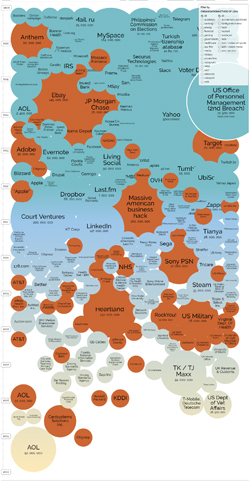
A computer security firm has discovered data it says belongs to some 152 million Adobe Systems Inc user accounts, suggesting that a breach reported a month ago is much larger than Adobe has so far disclosed and is one of the largest on record.

LastPass, a password security firm, said that it has found email addresses, encrypted passwords and password hints stored in clear text from Adobe user accounts on an underground website frequented by cyber criminals.
Adobe said last week that attackers had stolen data on more than 38 million customer accounts, on top of the theft of information on nearly 3 million accounts that it disclosed nearly a month earlier.
The maker of Photoshop and Acrobat software confirmed that LastPass had found records stolen from its data center, but downplayed the significance of the security firm’s findings.
While the new findings from LastPass indicate that the Adobe breach is far bigger than previously known, company spokeswoman Heather Edell said it was not accurate to say 152 million customer accounts had been compromised because the database attacked was a backup system about to be decommissioned.
She said the records include some 25 million records containing invalid email addresses, 18 million with invalid passwords. She added that “a large percentage” of the accounts were fictitious, having been set up for one-time use so that their creators could get free software or other perks.
She also said that the company is continuing to work with law enforcement and outside investigators to determine the cost and scope of the breach, which resulted in the theft of customer data as well as source code to several software titles.
The company has notified some 38 million active Adobe ID users and is now contacting holders of inactive accounts, she said.
Paul Stephens, director of policy and advocacy for the non-profit Privacy Rights Clearinghouse, said information in an inactive database is often useful to criminals.
He said they might use it to engage in “phishing” scams or attempt to figure out passwords using the hints provided for some of the accounts in the database. In some cases, people whose data was exposed might not be aware of it because they have not accessed the out-of-date accounts, he said.
“Potentially it’s the website you’ve forgotten about that poses the greater risk,” he said. “What if somebody set up an account with Adobe ten years ago and forgot about it and they use the same password there that they use on other sites?”
Google Expands Malware Blocker
Google has expanded malware blocking in an early development build of Chrome to sniff out a wider range of threats than the browser already recognizes.

Chrome’s current “Canary” build — the label for very-early versions of the browser, earlier than even Chrome’s Dev channel — will post a warning at the bottom of the window when it detects an attempted download of malicious code.
Features added to the Canary build usually, although not always, eventually make it into the Dev channel — the roughest-edged of the three distributed to users — and from there into the Beta and Stable channels. Google did not spell out a timetable for the expanded malware blocking.
Chrome has included malware blocking for more than two years, since version 12 launched in June 2011, and the functionality was extended in February 2012with Chrome 17.
Chrome is now at version 30.
Canary’s blocking, however, is more aggressive on two fronts: It is more assertive in its alerts and detects more malware forms, including threats that pose as legitimate software and monkey with the browser’s settings.
“Content.exe is malicious, and Chrome has blocked it,” the message in Canary reads. The sole visible option is to click the “Dismiss” button, which makes the warning vanish. The only additional option, and that only after another click, is to “Learn more,” which leads to yet another warning.
In Canary, there is no way for the user to contradict the malware blocking.
That’s different than in the current Stable build of Chrome, which relies on a message that says, “This file is malicious. Are you sure you want to continue?” and gives the user a choice between tossing the downloaded file or saving it anyway.
As it has for some time, Chrome will show such warnings on select file extensions, primarily “.exe,” which in Windows denotes an executable file, and “.msi,” an installation package for Windows applications. Canary’s expansion, said Google, also warns when the user tries to download some less obvious threats, including payloads masquerading as legitimate software — it cited screen savers and video plug-ins in a blog posting — that hijack browser settings to silently change the home page or insert ads into websites to monetize the malware.
Google’s malware blocking is part of its Safe Browsing API (application programming interface) and service, which Chrome, Apple’s Safari and Mozilla’s Firefox all access to warn customers of potentially dangerous websites before they reach them.
In Chrome’s case, the malware warning stems not only from the Safe Browsing “blacklist” of dodgy websites, but according to NSS Labs, a security software testing company, also from the Content Agnostic Malware Protection (CAMP) technology that Google has baked into its implementation of Safe Browsing.