





 Sign up for our Technology Newsletter

Are We Moving Too Fast Into Cloud Computing?
January 7, 2015 by admin
Filed under Around The Net
Comments Off on Are We Moving Too Fast Into Cloud Computing?
Businesses need to take a hybrid approach when it comes to the cloud, Dell has said.
The firm’s cloud strategy leader, Gordon Davey, told V3.co.uk in an interview that cloud computing is “overhyped” and moving an entire IT infrastructure into the cloud would be an unrealistic goal.
Davey also believes that cloud vendors have enticed companies to make major shifts to the cloud without considering a model that works for their business.
“I think it’s definitely a case of cloud as a buzzword is overhyped. The idea of cloud for the sake of cloud doesn’t really stand out,” he said.
“The problem comes from customers that have seen the buzzword and want to get the benefits and are just jumping on the bandwagon because it is an industry hype thing, rather than actually evaluating the benefits that a true cloud can bring, and applying that to their business requirements.”
Davey outlined the need to take a more considered approach, adopting an IT strategy that mixes on-premise infrastructure with cloud components to harness the technology without escalating IT costs and complexity.
“The future is going to be hybrid. It’s horses for courses – putting the right workload on the right platform,” he said.
“It’s that balanced approach that I think we’re going to see much more often, rather than trying to put everything into the cloud and potentially failing.”
Davey’s position is unsurprising given Dell’s approach of acting as a ‘middleman’ between cloud service providers and end users, providing hardware, software, services and consultancy to enable businesses to use cloud computing in a way that works for them.
“We see our role as enabling the cloud industry, being that underlying technology,” he said, going on to detail Dell’s five pillar approach to acting as a cloud middleman rather than developing its own end-to-end cloud offering.
The strategy involves consulting on a customer’s cloud needs, helping provide cloud infrastructure, brokering deals between vendors and users, providing security, and managing how multiple cloud services are deployed in a single business.
Davey claimed that Dell’s strategy will help companies take a more tailored approach to cloud adoption, adding: “A properly deployed cloud for the correct workloads in hugely beneficial.”
Dell is not alone in promoting a hybrid approach to cloud adoption. Microsoft is adding hybrid cloud capability to the next version of Windows Server.
Oracle Acquires Datalogix
On Monday, Oracle agreed to purchase Datalogix for an undisclosed sum, saying that together the companies will provide marketers with a richer understanding of what consumers do, say and buy, allowing them to measure the effectiveness of their different campaigns and advertising channels.

Oracle plans to link the Datalogix service, which provides the spending data to customers through a cloud-based tool, to its other cloud-based services via Oracle Identity Graph. This, it said, will allow it to connect consumer identities to build better profiles that can be used to personalize online and mobile services — and even to target them offline and via the TV.
It made no commitment to maintain the existing Datalogix product roadmap, saying that it was still reviewing its plans. The companies set no timeline for completing the deal, which they said must meet customary closing conditions including obtaining regulatory approval.
Will Marriott Block Wi-Fi
January 5, 2015 by admin
Filed under Around The Net
Comments Off on Will Marriott Block Wi-Fi
The U.S. Federal Communications Commission will render a decision on whether to establish rules regarding hotels’ ability to block personal Wi-Fi hotspots inside their buildings, a practice that recently earned Marriott International a $600,000 fine.

In August, Marriott, business partner Ryman Hospitality Properties and trade group the American Hotel and Lodging Association asked the FCC to clarify when hotels can block outside Wi-Fi hotspots in order to protect their internal Wi-Fi services.
In that petition, the hotel group asked the agency to “declare that the operator of a Wi-Fi network does not violate [U.S. law] by using FCC-authorized equipment to monitor and mitigate threats to the security and reliability of its network,” even when taking action causes interference to mobile devices.
The comment period for the petition ended Friday, so now it’s up to the FCC to either agree to Marriott’s petition or disregard it.
However, the FCC did act in October, slapping Marriott with the fine after customers complained about the practice. In their complaint, customers alleged that employees of Marriott’s Gaylord Opryland Hotel and Convention Center in Nashville used signal-blocking features of a Wi-Fi monitoring system to prevent customers from connecting to the Internet through their personal Wi-Fi hotspots. The hotel charged customers and exhibitors $250 to $1,000 per device to access Marriott’s Wi-Fi network.
During the comment period, several groups called for the agency to deny the hotel group’s petition.
The FCC made clear in October that blocking outside Wi-Fi hotspots is illegal, Google’s lawyers wrote in a comment. “While Google recognizes the importance of leaving operators flexibility to manage their own networks, this does not include intentionally blocking access to other commission-authorized networks, particularly where the purpose or effect of that interference is to drive traffic to the interfering operator’s own network,” they wrote.
Yet Another Retailer System Hacked
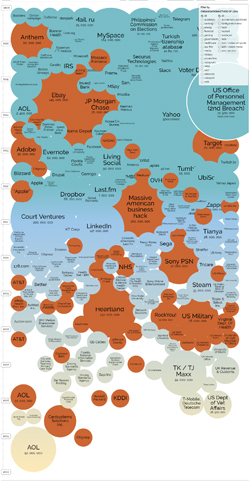
Women’s clothing retailer Bebe Stores has become the latest in a growing list of national retailers to be hit by an attack on its credit card payment system.

The company said Friday that the cardholder name, account number, expiration date, and verification code could have been stolen by hackers who apparently had access to the company’s payment processing system between Nov. 8 and 26.
The incident came to light in late November when Bebe said it noticed suspicious activity on computers that operate the payment processing system. Stores affected were the roughly 200 it operates in the U.S., Puerto Rico and the U.S. Virgin Islands.
“If you used a payment card at a U.S., Puerto Rico or U.S. Virgin Islands store during this time frame, you should review your account statements for any unauthorized activity,” it said in a message to customers.
The last couple of years have been bad ones for the safety of credit card data at major U.S. retailers. Millions of credit and debit card numbers have been compromised in breaches at retailers, including Target, Home Depot, PF Chang’s restaurants, Super Valu grocery stores, Neiman Marcus, UPS Store and others.
In many cases, the attacks were targeted at payment processing terminals and used sophisticated malware that stole card details as consumers swiped their cards. Many of the thefts were only discovered after the card numbers appeared for sale on Internet hacking forums.
Such was the case with Bebe Stores. First news of the hack came earlier this week through the closely followed Krebs on Security blog.
Cisco Files Suit Against Rivals
Network equipment maker Cisco Systems Inc filed several lawsuits on Friday against Arista Networks Inc, alleging the smaller rival of copying its networking technologies.

The lawsuits, filed in a federal court in California, accuse Arista of infringing on 14 patents on networks and also on related copyrights, Cisco General Counsel Mark Chandler said in a blog post.
Arista was formed by former Cisco employees, including Chief Development Officer Andreas Bechtolsheim, Chief Technology Officer Kenneth Duda, and Chief Executive Officer Jayshree Ullal.
“Rather than building its products and services based on new technologies developed by Arista, however, and providing legitimate competition to Cisco, Arista took a shortcut by blatantly and extensively copying the innovative networking technologies designed and developed by Cisco,” one of the complaints said.
Cisco is a leader in the networking world, with revenue of $12.2 billion in the third quarter. Arista, in contrast, reported sales of $155.5 million for the period, although it is growing fast.
Arista said it had not yet been able to evaluate the lawsuits.
“While we have respect for Cisco as a fierce competitor and the dominant player in the market, we are disappointed that they have to resort to litigation rather than simply compete with us in products,” Arista said in an emailed statement.
Cisco filed the lawsuits on the same day the U.S. Supreme Court agreed to review a $64 million patent infringement verdict that Commil USA LLC won against the company.
Google Moves To Drop CAPTCHA
December 16, 2014 by admin
Filed under Around The Net
Comments Off on Google Moves To Drop CAPTCHA
Google announced that it is trying to get rid of those annoying CAPTCHAs required by websites, which is short for Completely Automated Public Turing test to tell Computers and Humans Apart.

Instead of requiring that users fill in the letters and numbers shown in a distorted image, sites that use Google’s reCAPTCHA service will be able to use just one click, answering a simple question: Are you a robot?
“reCAPTCHA protects the websites you love from spam and abuse,” wrote Vinay Shet, product manager for Google’s reCAPTCHA service, in a blog post. “For years, we’ve prompted users to confirm they aren’t robots by asking them to read distorted text and type it into a box… But, we figured it would be easier to just directly ask our users whether or not they are robots. So, we did! ”
Google on Wednesday began rolling out a new API that rethinks the reCAPTCHA experience.
CAPTCHA “can be hard to read and frustrating for people, particularly on mobile devices,” said Zeus Kerravala, an analyst with ZK Research. “People often have to put in the text several times. On the surface, this seems a good way to improve the user experience. It still requires human intervention, just something simpler.”
CAPTCHAs were created to foil computer programs that hackers or spammers use to troll for access to websites or to collect email addresses.
Google said CAPTCHAs are less useful than they have been, although they are still frustrating to everyday users.
“CAPTCHAs have long relied on the inability of robots to solve distorted text,’ wrote Shet. “However, our research recently showed that today’s artificial intelligence technology can solve even the most difficult variant of distorted text at 99.8% accuracy. Thus distorted text, on its own, is no longer a dependable test.”
The new API, along with Google’s ability to analyze a user’s actions — before, during, and after clicking on the reCAPTCHA box — let’s the new technology figure out if the user is human or not.
“The new API is the next step in this steady evolution,” Shet stated. “Now humans can just check the box and in most cases, they’re through the challenge.”
MediaTek Cuts Xiaomi
The dark satanic rumour mill manufactured a hell on earth rumour that MediaTek has stopped supplying chips to Xiaomi.
MediaTek is apparently cross that Xiaomi has been investing in SoC supplier Leadcore Technology. Xiaomi has reportedly reached a deal with Leadcore allowing the phone maker to get access to the chip designer’s technology patents. DigiTimes however suggests that MediaTek has been trying to expand its presence in the mid-range and high-end market segments, but finds Xiaomi’s pricing strategy is disrupting its plans.
MediaTek’s MT6589T, a quad-core 1.5GHz chip, was originally designed to target mid-range and high-end mobile devices. The solution was introduced in Xiaomi’s Redmi smartphone in August 2013. However, prices for the Redmi series have been cut to as low as $114.
Xiaomi is ranked as the third largest smartphone vendor worldwide in the third quarter of 2014. Xiaomi’s shipments for the quarter registered a 211.3 per cent on-year jump boosting its market share to 5.3 per cent from 2.1 per cent during the same period of 2013.
Twitter To Track Mobile Users
December 11, 2014 by admin
Filed under Around The Net
Comments Off on Twitter To Track Mobile Users
Twitter Inc has plans to start tracking what third-party apps are installed on users’ mobile devices so the social media company can deliver more tailored content, including ads, the company has revealed.
The feature, called “app graph,” will allow the company to see what other applications users may have installed on phones or other devices.
“To help build a more personal Twitter experience for you, we are collecting and occasionally updating the list of apps installed on your mobile device so we can deliver tailored content that you might be interested in,” the company said on its site.
The posting also included instructions on how to turn the feature off. Twitter is not collecting data from within the applications, the posting noted.
Twitter, whose main service allows users to broadcast 140-character messages, has been searching for ways to re-invigorate user engagement and drive growth. As part of that effort, the company is considering creating additional mobile applications beyond its core messaging service.
Samsung Moves To Block nVidia
Samsung has moved to try and block the sales of Nvidia chips in the US.

Samsung has filed a complaint with the U.S. International Trade Commission as part of patent war which appears to have broken out between the two chipmakers. Samsung claims Nvidia infringed several of its chip-related patents and for making false claims about its products. This is effectively counter-suing after Nvidia filed a suit against the company in September making more or less the same charges.
Nvidia accused Samsung and rival Qualcomm of infringing patents on its graphics-processing unit (GPU). Samsung, which had filed the lawsuit in a US federal court on November 4, is seeking damages for deliberate infringement of several technical patents, including a few that govern the way semiconductors buffer and use data.
The ITC complaint also named computer-parts manufacturers Biostar Microtech and Elitegroup. These things run and run and usually wind up with a settlement where both sides agree to keep the details quiet. The ITC is often used as leverage in such cases because it deals with things a little quicker and a product embargo to the US can be seriously damage a company’s wealth.
Symantec Uncovers Advanced Spying Malware
Comments Off on Symantec Uncovers Advanced Spying Malware
An advanced malicious software application has been discovered that since 2008 was used to spy on private companies, governments, research institutes and individuals in 10 countries, anti virus software maker Symantec Corp said in a report on Sunday.

The Mountain View, California-based maker of Norton anti virus products said its research showed that a “nation state” was likely the developer of the malware called Regin, or Backdoor. Regin, but Symantec did not identify any countries or victims.
Symantec said Regin’s design “makes it highly suited for persistent, long-term surveillance operations against targets,” and was withdrawn in 2011 but resurfaced from 2013 onward.
The malware uses several “stealth” features “and even when its presence is detected, it is very difficult to ascertain what it is doing,” according to Symantec. It said “many components of Regin remain undiscovered and additional functionality and versions may exist.”
Almost half of all infections occurred at addresses of Internet service providers, the report said. It said the targets were customers of the companies rather than the companies themselves. About 28 percent of targets were in telecoms while other victims were in the energy, airline, hospitality and research sectors, Symantec said.
Symantec described the malware as having five stages, each “hidden and encrypted, with the exception of the first stage.” It said “each individual stage provides little information on the complete package. Only by acquiring all five stages is it possible to analyze and understand the threat.”
Regin also uses what is called a modular approach that allows it to load custom features tailored to targets, the same method applied in other malware, such as Flamer and Weevil (The Mask), the anti virus company said. Some of its features were also similar to Duqu malware, uncovered in September 2011 and related to a computer worm called Stuxnet, discovered the previous year.
Symantec said Russia and Saudi Arabia accounted for about half of the confirmed infections of the Regin malware and the other countries were Mexico, Ireland, India, Iran,Afghanistan, Belgium, Austria and Pakistan.