





 Sign up for our Technology Newsletter

Will Computer Obtain Common Sense?
Even though it may appear PCs are getting dumbed down as we see constant images of cats playing the piano or dogs playing in the snow, one computer is doing the same and getting smarter and smarter.

A computer cluster running the so-called the Never Ending Image Learner at Carnegie Mellon University runs 24 hours a day, 7 days a week searching the Internet for images, studying them on its own and building a visual database. The process, scientists say, is giving the computer an increasing amount of common sense.
“Images are the best way to learn visual properties,” said Abhinav Gupta, assistant research professor in Carnegie Mellon’s Robotics Institute. “Images also include a lot of common sense information about the world. People learn this by themselves and, with [this program], we hope that computers will do so as well.”
The computers have been running the program since late July, analyzing some three million images. The system has identified 1,500 types of objects in half a million images and 1,200 types of scenes in hundreds of thousands of images, according to the university.
The program has connected the dots to learn 2,500 associations from thousands of instances.
Thanks to advances in computer vision that enable software to identify and label objects found in images and recognize colors, materials and positioning, the Carnegie Mellon cluster is better understanding the visual world with each image it analyzes.
The program also is set up to enable a computer to make common sense associations, like buildings are vertical instead of lying on their sides, people eat food, and cars are found on roads. All the things that people take for granted, the computers now are learning without being told.
“People don’t always know how or what to teach computers,” said Abhinav Shrivastava, a robotics Ph.D. student at CMU and a lead researcher on the program. “But humans are good at telling computers when they are wrong.”
He noted, for instance, that a human might need to tell the computer that pink isn’t just the name of a singer but also is the name of a color.
While previous computer scientists have tried to “teach” computers about different real-world associations, compiling structured data for them, the job has always been far too vast to tackle successfully. CMU noted that Facebook alone has more than 200 billion images.
The only way for computers to scan enough images to understand the visual world is to let them do it on their own.
“What we have learned in the last five to 10 years of computer vision research is that the more data you have, the better computer vision becomes,” Gupta said.
CMU’s computer learning program is supported by Google and the Office of Naval Research.
Is SAP Searching In The Clouds?
Esoteric business software maker, which no one is really certain what it does, SAP is debating whether to accelerate moving more of its business to the cloud.
The move would be a change in strategy which might initially have only a small impact on its sales. Co-chief executive Jim Hagemann-Snabe said the change would generate more sales by 2017 particularly in markets like the US where there is a big push onto the cloud.
Talking to a Morgan Stanley investor conference this morning, Hagemann-Snabe said that this would have impact on the 2015 level, I don’t expect enormous impact but it would have some impact because you are delaying some revenues. In the long term however it makes a lot of sense, which is not the sort of thing people expect from SAP.
Researchers Build Flying Robot
December 4, 2013 by admin
Filed under Around The Net
Comments Off on Researchers Build Flying Robot
Researchers say they have assembled a flying robot. It’s not designed to fly like a bird or an insect, but was built to simulate the movements of a swimming jellyfish.

Scientists at New York University say they built the small, flying vehicle to move like the boneless, pulsating, water-dwelling jellyfish.
Leif Ristroph, a post-doctoral student at NYU and a lead researcher on the project, explained that previous flying robots were based on the flight of birds or insects, such as flies.
Last spring, for example, Harvard University researchers announced that they had built an insect-like robot that flies by flapping its wings. The flying robot is so small it has about 1/30th the weight of a U.S. penny.
Before the Harvard work was announced, researchers at the University of Sheffield and the University of Sussex in England worked together to study thebrains of honey bees in an attempt to build an autonomous flying robot.
By creating models of the systems in a bee’s brain that control vision and sense of smell, scientists hope to build a robot that would be able to sense and act as autonomously as a bee.
The problem with those designs, though, is that the flapping wing of a fly is inherently unstable, Ristroph noted.
“To stay in flight and to maneuver, a fly must constantly monitor its environment to sense every gust of wind or approaching predator, adjusting its flying motion to respond within fractions of a second,” Ristroph said. “To recreate that sort of complex control in a mechanical device — and to squeeze it into a small robotic frame — is extremely difficult.”
To get beyond those challenges, Ristroph built a prototype robot that is 8 centimeters wide and weighs two grams. The robot flies by flapping four wings arranged like petals on a flower that pulsate up and down, resembling the flying motion of a moth.
The machine, according to NYU, can hover and fly in a particular direction.
There is more work still to be done. Ristroph reported that his prototype doesn’t have a battery but is attached to an external power source. It also can’t steer, either autonomously or via remote control.
Twitter Tightens Security
Twitter Inc said it has put in place a security technology that makes it harder to spy on its users and called on other Internet firms to do the same, as Web providers look to thwart spying by government intelligence agencies.

The online messaging service, which began scrambling communications in 2011 using traditional HTTPS encryption, said on Friday it has added an advanced layer of protection for HTTPS known as “forward secrecy.”
“A year and a half ago, Twitter was first served completely over HTTPS,” the company said in a blog posting. “Since then, it has become clearer and clearer how important that step was to protecting our users’ privacy.”
Twitter’s move is the latest response from U.S. Internet firms following disclosures by former spy agency contractor Edward Snowden about widespread, classified U.S. government surveillance programs.
Facebook Inc, Google Inc, Microsoft Corp and Yahoo Inc have publicly complained that the government does not let them disclose data collection efforts. Some have adopted new privacy technologies to better secure user data.
Forward secrecy prevents attackers from exploiting one potential weakness in HTTPS, which is that large quantities of data can be unscrambled if spies are able to steal a single private “key” that is then used to encrypt all the data, said Dan Kaminsky, a well-known Internet security expert.
The more advanced technique repeatedly creates individual keys as new communications sessions are opened, making it impossible to use a master key to decrypt them, Kaminsky said.
“It is a good thing to do,” he said. “I’m glad this is the direction the industry is taking.”
Will nVidia’s Tegra 5 Go LTE?
The tradition continues. Our sources are confirming that Nvidia’s Logan SoC, possibly called Tegra 5, doesn’t come with an integrated LTE modem. Just like Apple, Nvidia makes a big fast chip with impressive Kepler based GPU, but it won’t put a an icera LTE solution inside the same chip.
Icera i500 is Tegra 5 compatible and it has AT&T certification. As the launch draws near, it should become compatible with other US and international LTE carriers like Verizon and T-mobile.
This should not be a big issue for Nvidia’s target market, manufacturers will have to choose two chips instead of one, a clear competitive disadvantage compared to future Qualcomm chips with Adreno 400 graphics and updated CPU cores, expected in early 2014.
During Nvidia’s recent conference call, CEO Jen Hsun Huang said devices based on the new Tegra 4i with integrated LTE should be announced in Q1 and ship no later than Q2. Jensen also mentioned that people are going to be “delighted by the OEM that it comes from” which is probably his way of of announcing some big brand design wins, but he also emphasised that the designs will be global rather than US. For US success you need CDMA Jensen said, but as far as we know Verizon is the only company using it.
Since Apple can pull of two chip designs from day one, we can only assume that two chip approach won’t cost much battery life compared to single chip design that has LTE on board (Snapdragon 600 and 800 ed. ). However, Nvidia is likely going to be making bets on its Kepler based GPU, expected to be the fastest graphics core ever integrated in a mobile SoC that will rock tablets and some phones around the world. The fact that Logan is likely to pack very powerful graphics sans on-die LTE makes it a bit more interesting for tablets than phones, which is exactly what we saw with the Tegra 4.
We expect to see Tegra 5 devices announced at CES 2014 so early January and with some luck we might see them shipping very early in 2014.
Did Stuxnet Infect A Russian Nuclear Plant?
Comments Off on Did Stuxnet Infect A Russian Nuclear Plant?
Kaspersky has claimed that the infamous Stuxnet computer worm “badly infected” the internal network of an unnamed Russian nuclear plant after it caused chaos in Iran’s nuclear facilities.

Speaking at a keynote presentation given at the Canberra Press Club 2013, Kaspersky CEO Eugene Kaspersky said a staffer at the unnamed nuclear plant informed him of the infection.
“[The staffer said] their nuclear plant network which was disconnected from the internet was badly infected by Stuxnet,” Kaspersky said.
“So unfortunately these people who were responsible for offensive technologies, they recognise cyber weapons as an opportunity.”
Stuxnet was discovered to have spread throughout industrial software and equipment in 2010 and is believed to have been created by the United States and Israel to attack Iran’s nuclear facilities. According to Kaspersky’s source, the malware was carried into the Russian nuclear plant and installed on a physically separated “air-gapped” network.
Kaspersky also made a rather outlandish joke during his speech, saying that all data is subject to theft. “All the data is stolen,” Kaspersky said. “At least twice.”
“If the claim of the Russian nuclear plant infection is true, then it’s easy to imagine how this “collateral damage” could have turned into a very serious incident indeed, with obvious diplomatic repercussions,” said security expert Graham Cluley.
“There is no way to independently verify the claim, of course. But it is a fact that Stuxnet managed to infect many computer systems outside of its intended target in Iran,” Cluley added. “Indeed, the very fact that it spread out of control, was what lead to its discovery by security firms.”
Earlier this year, Symantec claimed that the Stuxnet computer worm could date back further than 2010 and was more widespread than originally believed.
Symantec’s report called “The Missing Link” found a build of the Stuxnet attack tool, dubbed Stuxnet 0.5, which it said dated back to 2005 and used different techniques to sabotage industrial facilities.
Adobe Data Found Online
November 18, 2013 by admin
Filed under Around The Net
Comments Off on Adobe Data Found Online
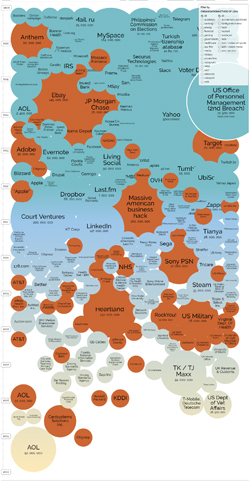
A computer security firm has discovered data it says belongs to some 152 million Adobe Systems Inc user accounts, suggesting that a breach reported a month ago is much larger than Adobe has so far disclosed and is one of the largest on record.

LastPass, a password security firm, said that it has found email addresses, encrypted passwords and password hints stored in clear text from Adobe user accounts on an underground website frequented by cyber criminals.
Adobe said last week that attackers had stolen data on more than 38 million customer accounts, on top of the theft of information on nearly 3 million accounts that it disclosed nearly a month earlier.
The maker of Photoshop and Acrobat software confirmed that LastPass had found records stolen from its data center, but downplayed the significance of the security firm’s findings.
While the new findings from LastPass indicate that the Adobe breach is far bigger than previously known, company spokeswoman Heather Edell said it was not accurate to say 152 million customer accounts had been compromised because the database attacked was a backup system about to be decommissioned.
She said the records include some 25 million records containing invalid email addresses, 18 million with invalid passwords. She added that “a large percentage” of the accounts were fictitious, having been set up for one-time use so that their creators could get free software or other perks.
She also said that the company is continuing to work with law enforcement and outside investigators to determine the cost and scope of the breach, which resulted in the theft of customer data as well as source code to several software titles.
The company has notified some 38 million active Adobe ID users and is now contacting holders of inactive accounts, she said.
Paul Stephens, director of policy and advocacy for the non-profit Privacy Rights Clearinghouse, said information in an inactive database is often useful to criminals.
He said they might use it to engage in “phishing” scams or attempt to figure out passwords using the hints provided for some of the accounts in the database. In some cases, people whose data was exposed might not be aware of it because they have not accessed the out-of-date accounts, he said.
“Potentially it’s the website you’ve forgotten about that poses the greater risk,” he said. “What if somebody set up an account with Adobe ten years ago and forgot about it and they use the same password there that they use on other sites?”
Raspberry PI Breaks Record
Sinclair ZX80 and runaway success story, the Raspberry Pi might be about to get its own monitor after a Kickstarter campaign to create a low cost 9in screen for it has exceeded its $90,000 goal in a single weekend.
The HDMIPi monitor from startup Raspi.tv presently stands at $100,996 on Kickstarter, an increase of $8,000 in just the last four hours. The concept behind the monitor is to create something small and affordable but with maximum 1920×1080 resolution. Even though the project has had to scale down its ambitions to 1200×800 resolution to fit the business plan, Raspberry Pi fans have flocked to crowdfund the device.
Put in perspective, that’s higher than HD 720p resolution, or as they describe it, “slightly better resolution than the 720p HD footage on BBC iPlayer”.
Monitor cases will be available in a variety of colours, designed by none other than Paul Beech, who designed the original Raspberry Pi logo.
Although primarily designed for the Raspberry Pi, the HDMIPi is a standard HDMI monitor and can be used for other devices – Android sticks, video cameras, games consoles and beyond.
Raspi.tv has pledged to ship orders in February 2014, delays permitting, and is already working on enhancements. It has described touch functionality as something that might become available as a bolt-on at a later date, saying that “enough people have mentioned it that we are sitting up and taking notice”.
As ever with the Raspberry Pi ecosystem, everything is a bit Ryanair, and power supplies, surrounds and so on are not automatically included, though of course, in the true DIY spirit, you can always make your own.
Africa To Lead Global Bandwidth Demand
Comments Off on Africa To Lead Global Bandwidth Demand
Africa’s demand for Internet access to the rest of the world will grow by an average of 51 percent every year until 2019, ahead of all other regions, according to a forecast by research company Telegeography.

Rapid economic growth and wider Internet use will drive the increase in demand, which will be met mostly by turning on unused capacity in existing cables, according to Telegeography analyst Erik Kreifeldt. Terrestrial links are in demand partly because much of Africa still relies on satellite, which is far more expensive per bit than wired broadband, he said.
Most Internet bandwidth between continents is provided by undersea cables built and financed by groups of service providers. From Africa, most of those links go to Europe. Other carriers pay to tap into those cables and link their customers to the Internet. In some parts of Africa, running cables from coastal areas to the interior is a challenge so satellite remains the major Internet source, Kreifeldt said.
The capacity of international cables landing on African shores is just a fraction of the bandwidth available between Europe, the U.S. and Asia. After seven years of the growth that Telegeography forecasts, from 2012 through 2019, Africa will have 17.2Tbps (bits per second) of links to the outside world. That’s up from just 957Gbps in 2012 but will still be only about one-quarter of the international capacity of Latin America and less than that of Canada, according to Telegeography.
The hunger for the Internet varies among African countries. Through 2019, bandwidth demand is expected to grow fastest in Angola, at 71 percent per year; Tanzania, at 68 percent; and Gabon, at 67 percent.
Many new cables have been built to Africa and around the continent in the past several years, giving service providers excess fiber capacity that can be turned on when needed, Kreifeldt said. As that fiber gets lit up and supply rises, prices should fall for enterprises and other users in African countries, he said. However, due to relative scarcity, a given amount of bandwidth between Africa and Europe costs about 10 times as much as the same size connection between Europe and North America, he said. Africa’s bandwidth gains aren’t expected to shrink that gap.
ATM Malware Found In Mexico
A malicious software program identified in ATMs in Mexico has been improved and translated into English, which suggests it may be used elsewhere, according to security vendor Symantec.

Two versions of the malware, called Ploutus, have been discovered, both of which are engineered to empty a certain type of ATM, which Symantec has not identified.
In contrast to most malware, Ploutus is installed the old-fashioned way — by inserting a CD boot disk into the innards of an ATM machine running Microsoft Windows. The installation method suggests that cybercriminals are targeting standalone ATMs where access is easier.
The first version of Ploutus displays a graphical user interface after the thief enters a numerical sequence on an ATM’s keypad, although the malware can be controlled by a keyboard, wrote Daniel Regalado, a Symantec malware analyst, on Oct. 11.
Ploutus is programmed for a specific ATM model since it assumes there is a maximum of four cassettes per dispenser in the ATM. It then calculates the amount of money that should be dispensed based on the number of bills. If any of the cassettes have less than the maximum number of 40 bills, it releases whatever is left, repeating that process until the ATM is empty.
Kevin Haley, director of Symantec Security Response, said in an interview earlier this month that the attackers have deep knowledge of the software and hardware of the particular ATM model.
“They clearly know how this machine worked,” he said.
The source code of Ploutus “contains Spanish function names and poor English grammar that suggests the malware may have been coded by Spanish-speaking developers,” Regalado wrote.
In a new blog post, Regalado wrote that the attackers made Ploutus more robust and translated it into English, indicating the same ATM software can be exploited in countries other than Mexico.
The “B” variant of Ploutus has some differences. It only accepts commands through the keypad but will display a window showing the money available in the machine along with a transaction log as it dispenses cash. An attacker cannot enter a specific number of bills, so Ploutus withdraws money from the cassette with the most available bills, Regalado wrote.
Symantec advised those with ATMs to change the BIOS boot order to only boot from the hard disk and not CDs, DVDs or USB sticks. The BIOS should also be password protected so the boot options can’t be changed, Regalado wrote.