





 Sign up for our Technology Newsletter

Is SAP Searching In The Clouds?
Esoteric business software maker, which no one is really certain what it does, SAP is debating whether to accelerate moving more of its business to the cloud.
The move would be a change in strategy which might initially have only a small impact on its sales. Co-chief executive Jim Hagemann-Snabe said the change would generate more sales by 2017 particularly in markets like the US where there is a big push onto the cloud.
Talking to a Morgan Stanley investor conference this morning, Hagemann-Snabe said that this would have impact on the 2015 level, I don’t expect enormous impact but it would have some impact because you are delaying some revenues. In the long term however it makes a lot of sense, which is not the sort of thing people expect from SAP.
3D Printer Goes Retail
December 3, 2013 by admin
Filed under Around The Net
Comments Off on 3D Printer Goes Retail
MakerBot, a 3D printer maker which opened two new retail stores last week, is among the companies trying to bring the cutting-edge digital manufacturing technology to Main Street consumers, but skeptics say the debut may be premature.

MakerBot, a unit of Stratasys Ltd, opened retail stores this week in Boston and in Greenwich, Connecticut, both of which are twice the size of MakerBot’s first store, 1,500 square feet in downtown Manhattan.
The company offers designs for more than 100,000 items through its “Thingiverse” online user community. The products range from knick-knacks like zombie sculptures to jewelry, sink drains and even medical devices. They are printed using its line of corn-based plastic fibers in more than a dozen colors.
“For most people 3D printing is futuristic science fiction. We’re here to make it real,” said CEO Bre Pettis, who cut the ribbon at the store on Boston’s fashionable Newbury Street using scissors made on one of MakerBot’s Replicator printers which start at $2,199.
Pettis, who has purchased splashy magazine ads to promote 3D printers as holiday gifts, believes there could soon be a 3D printer on every block in America.
Yet some technology experts say 3D printers may not be ready for prime time because they are still much less user friendly than most modern consumer electronics.
“There is so much hype,” said Pete Basiliere, an analyst at technology research firm Gartner. “People are getting a little bit misled as to how easy it is,” he said.
Some investors also are skeptical of 3D printing’s readiness for the market. Short-seller Citron this week published an article questioning the earnings of Germany’s voxeljet AG’s, and shares in the sector fell, including those of MakerBot parent Stratasys and rivals 3D Systems Corp and ExOne Co.
Twitter Tightens Security
Twitter Inc said it has put in place a security technology that makes it harder to spy on its users and called on other Internet firms to do the same, as Web providers look to thwart spying by government intelligence agencies.

The online messaging service, which began scrambling communications in 2011 using traditional HTTPS encryption, said on Friday it has added an advanced layer of protection for HTTPS known as “forward secrecy.”
“A year and a half ago, Twitter was first served completely over HTTPS,” the company said in a blog posting. “Since then, it has become clearer and clearer how important that step was to protecting our users’ privacy.”
Twitter’s move is the latest response from U.S. Internet firms following disclosures by former spy agency contractor Edward Snowden about widespread, classified U.S. government surveillance programs.
Facebook Inc, Google Inc, Microsoft Corp and Yahoo Inc have publicly complained that the government does not let them disclose data collection efforts. Some have adopted new privacy technologies to better secure user data.
Forward secrecy prevents attackers from exploiting one potential weakness in HTTPS, which is that large quantities of data can be unscrambled if spies are able to steal a single private “key” that is then used to encrypt all the data, said Dan Kaminsky, a well-known Internet security expert.
The more advanced technique repeatedly creates individual keys as new communications sessions are opened, making it impossible to use a master key to decrypt them, Kaminsky said.
“It is a good thing to do,” he said. “I’m glad this is the direction the industry is taking.”
Tizen Announces New Partners
November 25, 2013 by admin
Filed under Smartphones
Comments Off on Tizen Announces New Partners
Samsung and Intel announced on Tuesday that the open source Tizen operating system now has 36 partners, including eBay, Trend Micro and Panasonic.
The full list of new partners was announced at the Tizen Developer Summit, and includes a mix of firms from different sectors. Among the 36 backers are eBay, Nokia’s Here mapping service, Konami, McAfee, Panasonic, Sharp and The Weather Channel, giving us some insights as to what software applications are likely to appear on the Linux based operating system.
Trevor Cornwell, founder and CEO of Appbackr, one of Tizen’s newly added partners, said that his firm found the operating system appealing due to its open nature, perhaps hinting that it is more open than Google’s Android mobile operating system.
He said, “The Tizen OS promises to be the most open and comprehensive software platform available for those companies wishing to target the consumers of connected devices.
“The Association’s commitment to support HTML5 applications, combined with their vision that extends beyond the smartphone and tablet ecosystem to a wider array of other connected device segments, makes it attractive to all types of companies. We look forward to collaborating with the Tizen Association to ensure that all stakeholders can contribute to the development of a platform for this growing market opportunity.”
It’s still unclear when Samsung’s first Tizen powered smartphone will make it to market, but online speculation suggests we’ll be seeing the firm’s debut Android challenging smartphone at some point in 2014.
Further speculation suggests that Samsung’s first Tizen phone will be an updated version of the Galaxy S4, possibly to reduce its reliance on Android.
Will nVidia’s Tegra 5 Go LTE?
The tradition continues. Our sources are confirming that Nvidia’s Logan SoC, possibly called Tegra 5, doesn’t come with an integrated LTE modem. Just like Apple, Nvidia makes a big fast chip with impressive Kepler based GPU, but it won’t put a an icera LTE solution inside the same chip.
Icera i500 is Tegra 5 compatible and it has AT&T certification. As the launch draws near, it should become compatible with other US and international LTE carriers like Verizon and T-mobile.
This should not be a big issue for Nvidia’s target market, manufacturers will have to choose two chips instead of one, a clear competitive disadvantage compared to future Qualcomm chips with Adreno 400 graphics and updated CPU cores, expected in early 2014.
During Nvidia’s recent conference call, CEO Jen Hsun Huang said devices based on the new Tegra 4i with integrated LTE should be announced in Q1 and ship no later than Q2. Jensen also mentioned that people are going to be “delighted by the OEM that it comes from” which is probably his way of of announcing some big brand design wins, but he also emphasised that the designs will be global rather than US. For US success you need CDMA Jensen said, but as far as we know Verizon is the only company using it.
Since Apple can pull of two chip designs from day one, we can only assume that two chip approach won’t cost much battery life compared to single chip design that has LTE on board (Snapdragon 600 and 800 ed. ). However, Nvidia is likely going to be making bets on its Kepler based GPU, expected to be the fastest graphics core ever integrated in a mobile SoC that will rock tablets and some phones around the world. The fact that Logan is likely to pack very powerful graphics sans on-die LTE makes it a bit more interesting for tablets than phones, which is exactly what we saw with the Tegra 4.
We expect to see Tegra 5 devices announced at CES 2014 so early January and with some luck we might see them shipping very early in 2014.
Can Acer Go High-End?
Most popular for its low-cost laptops, Acer doesn’t really inspire thoughts of premium products. But building high-end hardware could be the Taiwanese vendor’s best chance as it looks for a way to rescue its struggling business.

With consumers flocking to tablets and smartphones, Acer’s once-thriving PC business has been left in the dust. Quarterly financial losses have become routine at the company and its PC shipments declined more sharply in the past year than at any other major vendor, according to IDC.
The grim situation forced CEO J.T. Wang to resign from his post last Tuesday. Acer will also cut 7 percent of its global workforce and has assembled an advisory committee to come up with a new strategy, the company announced.
Bright spots are hard to find. The Wintel model that propelled Acer for years and helped it become the second-largest PC vendor in 2009 has been falling apart amid the demand for mobile gadgets. And Windows 8 and Intel’s Ultrabook strategy have failed to resuscitate the market.
It hasn’t helped that Acer is so reliant on sales to consumers, said IDC analyst Bryan Ma. The entire PC industry has been hurt by tablets, but Dell and Hewlett-Packard have at least managed to find cover selling PCs to businesses, which are still buying them. And Lenovo has capitalized on its position in China, now the world’s largest PC market.
“Acer didn’t really have the commercial PC business to protect themselves. That’s why they were hit harder,” Ma said.
Acer — whether to its benefit or detriment — has instead gained a reputation for low-priced PCs. Even in tablets it has tried to undercut rivals — its Iconia W4, an 8-inch Windows 8.1 tablet, starts at US$329.99, while its Iconia B Android tablet goes for $129.99. The low prices have helped keep the company on consumers’ radar, but at the expense of profits.
One option for Acer is to build a brand as a higher-end PC player. It took a step in that direction last year with the Aspire S7, a Windows laptop with a slender, aluminum chassis that sells for $1,200 and up. That product and its successors have had some success for the company, with sales of 2,000 to 3,000 units per month, said James Wang, an analyst with research firm Canalys.
“I think Acer has started to learn they are able to sell some expensive products,” he said.
Selling higher-end PCs could help stop the bleeding in Acer’s finances, but with the overall PC market still shrinking it’s unlikely to help it expand in any meaningful way. “You can’t really expect vendors in desktops and notebooks to find growth,” Wang said. “You win in the market by not falling in shipments.”
Can Robots Run On (NH2)2CO?
November 19, 2013 by admin
Filed under Around The Net
Comments Off on Can Robots Run On (NH2)2CO?
Scientists have discovered a way to power future robots using an unusual source — urine.

Researchers at the University of the West of England, Bristol and the University of Bristol collaborated to build a system that will enable robots to function without batteries or being plugged into an electrical outlet.
Based on the functioning of the human heart, the system is designed to pump urine into the robot’s “engine room,” converting the waste into electricity and enabling the robot to function completely on its own.
Scientists are hoping the system, which can hold 24.5 ml of urine, could be used to power future generations of robots, or what they’re calling EcoBots.
“In the city environment, they could re-charge using urine from urinals in public lavatories,” said Peter Walters, a researcher with the University of the West of England. “In rural environments, liquid waste effluent could be collected from farms.”
In the past 10 years, researchers have built four generations of EcoBots, each able to use microorganisms to digest the waste material and generate electricity from it, the university said.
Along with using human and animal urine, the robotic system also can create power by using rotten fruit and vegetables, dead flies, waste water and sludge.
Ioannis Ieropoulos, a scientist with the Bristol Robotics Laboratory, explained that the microorganisms work inside microbial fuel cells where they metabolize the organics, converting them into carbon dioxide and electricity.
Like the human heart, the robotic system works by using artificial muscles that compress a soft area in the center of the device, forcing fluid to be expelled through an outlet and delivered to the fuel cells. The artificial muscles then relax and go through the process again for the next cycle.
“The artificial heartbeat is mechanically simpler than a conventional electric motor-driven pump by virtue of the fact that it employs artificial muscle fibers to create the pumping action, rather than an electric motor, which is by comparison a more complex mechanical assembly,” Walter said.
Adobe Data Found Online
November 18, 2013 by admin
Filed under Around The Net
Comments Off on Adobe Data Found Online
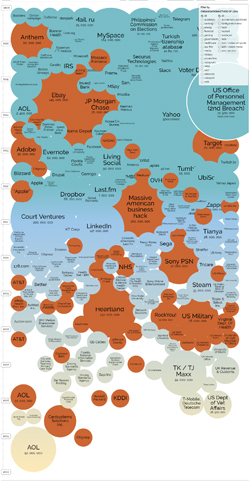
A computer security firm has discovered data it says belongs to some 152 million Adobe Systems Inc user accounts, suggesting that a breach reported a month ago is much larger than Adobe has so far disclosed and is one of the largest on record.

LastPass, a password security firm, said that it has found email addresses, encrypted passwords and password hints stored in clear text from Adobe user accounts on an underground website frequented by cyber criminals.
Adobe said last week that attackers had stolen data on more than 38 million customer accounts, on top of the theft of information on nearly 3 million accounts that it disclosed nearly a month earlier.
The maker of Photoshop and Acrobat software confirmed that LastPass had found records stolen from its data center, but downplayed the significance of the security firm’s findings.
While the new findings from LastPass indicate that the Adobe breach is far bigger than previously known, company spokeswoman Heather Edell said it was not accurate to say 152 million customer accounts had been compromised because the database attacked was a backup system about to be decommissioned.
She said the records include some 25 million records containing invalid email addresses, 18 million with invalid passwords. She added that “a large percentage” of the accounts were fictitious, having been set up for one-time use so that their creators could get free software or other perks.
She also said that the company is continuing to work with law enforcement and outside investigators to determine the cost and scope of the breach, which resulted in the theft of customer data as well as source code to several software titles.
The company has notified some 38 million active Adobe ID users and is now contacting holders of inactive accounts, she said.
Paul Stephens, director of policy and advocacy for the non-profit Privacy Rights Clearinghouse, said information in an inactive database is often useful to criminals.
He said they might use it to engage in “phishing” scams or attempt to figure out passwords using the hints provided for some of the accounts in the database. In some cases, people whose data was exposed might not be aware of it because they have not accessed the out-of-date accounts, he said.
“Potentially it’s the website you’ve forgotten about that poses the greater risk,” he said. “What if somebody set up an account with Adobe ten years ago and forgot about it and they use the same password there that they use on other sites?”
Panasonic Drops Plasma
November 12, 2013 by admin
Filed under Consumer Electronics
Comments Off on Panasonic Drops Plasma
Panasonic has announced it will discontinue production of plasma display panels (PDP) next month and close three factories that were building the HDTVs.

The company will stop selling plasma TVs for consumer use and PDP-related products for commercial use, such as Interactive Plasma Displays, with the current line of TVs. It expects to stop business operations at three of its display plants — the Amagasaki P3 Factory, the Amagasaki P5 Factory and the Amagasaki P4 Factory — by the end of March 2014.
Samsung and LG continue to produce plasma display televisions, but theirs are lower-end or entry-level models; they have generally put development dollars into LCD TVs, according to Paul Gray, a research analyst with NPD DisplaySearch.
“Samsung and [LG] were at best uncommitted to PDP,” Gray said in a blog post. And as for Panasonic, Gray said its “PDP research team had to counter every move in LCD and translate it to their technology…. Inevitably, they slowly lost ground.”
Since 2000, Panasonic has been the leading PDP maker. It led the global flat-panel display market by using PDP for large displays and LCD screens for small- and medium-sized displays. Only three years ago, Panasonic claimed 40% of the plasma display market.
In 2010, plasmaaccounted for 40% of flat panel TVs; this year, PDPs are expected to represent only 5% of the flat-panel market, according to according to market research firm NPD DisplaySearch.
Over the past two years, Panasonic has lost $15 billion through investments in flat-panel TV production, according to financial reports.
Plasma displays have increasingly lost market share to LCD TVs as they moved to LED backlights that narrowed the performance gap between the two technologies.
“With the rapid development of large-screen LCDs, and facing the severe price competition in the global market brought on by the Lehman Shock in September 2008, the company consolidated production in the Amagasaki P4 Factory, made a shift towards commercial applications and worked to improve the earnings of the business,” Panasonic said in a recent statement.
Panasonic will now focus its attention on “non-TV applications” and is moving to reduce its fixed costs for production of both plasma and LCD panels.
The move away from plasma HDTVs is reminiscent of the video tape wars of the 1970s and 1980s.
Africa To Lead Global Bandwidth Demand
Comments Off on Africa To Lead Global Bandwidth Demand
Africa’s demand for Internet access to the rest of the world will grow by an average of 51 percent every year until 2019, ahead of all other regions, according to a forecast by research company Telegeography.

Rapid economic growth and wider Internet use will drive the increase in demand, which will be met mostly by turning on unused capacity in existing cables, according to Telegeography analyst Erik Kreifeldt. Terrestrial links are in demand partly because much of Africa still relies on satellite, which is far more expensive per bit than wired broadband, he said.
Most Internet bandwidth between continents is provided by undersea cables built and financed by groups of service providers. From Africa, most of those links go to Europe. Other carriers pay to tap into those cables and link their customers to the Internet. In some parts of Africa, running cables from coastal areas to the interior is a challenge so satellite remains the major Internet source, Kreifeldt said.
The capacity of international cables landing on African shores is just a fraction of the bandwidth available between Europe, the U.S. and Asia. After seven years of the growth that Telegeography forecasts, from 2012 through 2019, Africa will have 17.2Tbps (bits per second) of links to the outside world. That’s up from just 957Gbps in 2012 but will still be only about one-quarter of the international capacity of Latin America and less than that of Canada, according to Telegeography.
The hunger for the Internet varies among African countries. Through 2019, bandwidth demand is expected to grow fastest in Angola, at 71 percent per year; Tanzania, at 68 percent; and Gabon, at 67 percent.
Many new cables have been built to Africa and around the continent in the past several years, giving service providers excess fiber capacity that can be turned on when needed, Kreifeldt said. As that fiber gets lit up and supply rises, prices should fall for enterprises and other users in African countries, he said. However, due to relative scarcity, a given amount of bandwidth between Africa and Europe costs about 10 times as much as the same size connection between Europe and North America, he said. Africa’s bandwidth gains aren’t expected to shrink that gap.