





 Sign up for our Technology Newsletter

Intel Buys KNO Software
Intel has acquired educational software developer Kno to add to its Education division.
Speaking in the company blog, Intel Sales and Marketing Group VP John Galvin explained that in a world where kids are being bombarded by technology, Intel Education has a mission to support the rollout of technology in the classroom.
Galvin said, “The Kno platform provides administrators and teachers with the tools they need to easily assign, manage and monitor their digital learning content and assessments.”
This acquisition brings Intel’s global digital content library to over 225,000 [higher education] and K-12 titles from 74 education publishers. “We’re looking forward to combining our expertise with Kno’s rich content so that together, we can help teachers create classroom environments and personalized learning experiences that lead to student success,” Galvin added.
Intel Education has been working for the past decade with over 10 million teachers that it has assisted to integrate technology with education.
In the UK alone there have been tremendous strides in educational software over the past 30 years, dating back to the government pledge to provide a computer in every school, which led to the creation of the BBC Microcomputer designed specifically for that purpose.
Today, not only is ICT a dedicated lesson in its own right, but it forms one of the key skills that educators are expected to incorporate into all lesson plans, putting it on a par with English and Maths, showing just how far we’ve come from making Venn diagrams with ascii art.
Tizen Announces New Partners
November 25, 2013 by admin
Filed under Smartphones
Comments Off on Tizen Announces New Partners
Samsung and Intel announced on Tuesday that the open source Tizen operating system now has 36 partners, including eBay, Trend Micro and Panasonic.
The full list of new partners was announced at the Tizen Developer Summit, and includes a mix of firms from different sectors. Among the 36 backers are eBay, Nokia’s Here mapping service, Konami, McAfee, Panasonic, Sharp and The Weather Channel, giving us some insights as to what software applications are likely to appear on the Linux based operating system.
Trevor Cornwell, founder and CEO of Appbackr, one of Tizen’s newly added partners, said that his firm found the operating system appealing due to its open nature, perhaps hinting that it is more open than Google’s Android mobile operating system.
He said, “The Tizen OS promises to be the most open and comprehensive software platform available for those companies wishing to target the consumers of connected devices.
“The Association’s commitment to support HTML5 applications, combined with their vision that extends beyond the smartphone and tablet ecosystem to a wider array of other connected device segments, makes it attractive to all types of companies. We look forward to collaborating with the Tizen Association to ensure that all stakeholders can contribute to the development of a platform for this growing market opportunity.”
It’s still unclear when Samsung’s first Tizen powered smartphone will make it to market, but online speculation suggests we’ll be seeing the firm’s debut Android challenging smartphone at some point in 2014.
Further speculation suggests that Samsung’s first Tizen phone will be an updated version of the Galaxy S4, possibly to reduce its reliance on Android.
Did Stuxnet Infect A Russian Nuclear Plant?
Comments Off on Did Stuxnet Infect A Russian Nuclear Plant?
Kaspersky has claimed that the infamous Stuxnet computer worm “badly infected” the internal network of an unnamed Russian nuclear plant after it caused chaos in Iran’s nuclear facilities.

Speaking at a keynote presentation given at the Canberra Press Club 2013, Kaspersky CEO Eugene Kaspersky said a staffer at the unnamed nuclear plant informed him of the infection.
“[The staffer said] their nuclear plant network which was disconnected from the internet was badly infected by Stuxnet,” Kaspersky said.
“So unfortunately these people who were responsible for offensive technologies, they recognise cyber weapons as an opportunity.”
Stuxnet was discovered to have spread throughout industrial software and equipment in 2010 and is believed to have been created by the United States and Israel to attack Iran’s nuclear facilities. According to Kaspersky’s source, the malware was carried into the Russian nuclear plant and installed on a physically separated “air-gapped” network.
Kaspersky also made a rather outlandish joke during his speech, saying that all data is subject to theft. “All the data is stolen,” Kaspersky said. “At least twice.”
“If the claim of the Russian nuclear plant infection is true, then it’s easy to imagine how this “collateral damage” could have turned into a very serious incident indeed, with obvious diplomatic repercussions,” said security expert Graham Cluley.
“There is no way to independently verify the claim, of course. But it is a fact that Stuxnet managed to infect many computer systems outside of its intended target in Iran,” Cluley added. “Indeed, the very fact that it spread out of control, was what lead to its discovery by security firms.”
Earlier this year, Symantec claimed that the Stuxnet computer worm could date back further than 2010 and was more widespread than originally believed.
Symantec’s report called “The Missing Link” found a build of the Stuxnet attack tool, dubbed Stuxnet 0.5, which it said dated back to 2005 and used different techniques to sabotage industrial facilities.
Adobe Data Found Online
November 18, 2013 by admin
Filed under Around The Net
Comments Off on Adobe Data Found Online
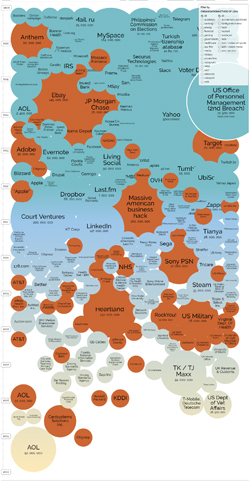
A computer security firm has discovered data it says belongs to some 152 million Adobe Systems Inc user accounts, suggesting that a breach reported a month ago is much larger than Adobe has so far disclosed and is one of the largest on record.

LastPass, a password security firm, said that it has found email addresses, encrypted passwords and password hints stored in clear text from Adobe user accounts on an underground website frequented by cyber criminals.
Adobe said last week that attackers had stolen data on more than 38 million customer accounts, on top of the theft of information on nearly 3 million accounts that it disclosed nearly a month earlier.
The maker of Photoshop and Acrobat software confirmed that LastPass had found records stolen from its data center, but downplayed the significance of the security firm’s findings.
While the new findings from LastPass indicate that the Adobe breach is far bigger than previously known, company spokeswoman Heather Edell said it was not accurate to say 152 million customer accounts had been compromised because the database attacked was a backup system about to be decommissioned.
She said the records include some 25 million records containing invalid email addresses, 18 million with invalid passwords. She added that “a large percentage” of the accounts were fictitious, having been set up for one-time use so that their creators could get free software or other perks.
She also said that the company is continuing to work with law enforcement and outside investigators to determine the cost and scope of the breach, which resulted in the theft of customer data as well as source code to several software titles.
The company has notified some 38 million active Adobe ID users and is now contacting holders of inactive accounts, she said.
Paul Stephens, director of policy and advocacy for the non-profit Privacy Rights Clearinghouse, said information in an inactive database is often useful to criminals.
He said they might use it to engage in “phishing” scams or attempt to figure out passwords using the hints provided for some of the accounts in the database. In some cases, people whose data was exposed might not be aware of it because they have not accessed the out-of-date accounts, he said.
“Potentially it’s the website you’ve forgotten about that poses the greater risk,” he said. “What if somebody set up an account with Adobe ten years ago and forgot about it and they use the same password there that they use on other sites?”
Google Expands Malware Blocker
Google has expanded malware blocking in an early development build of Chrome to sniff out a wider range of threats than the browser already recognizes.

Chrome’s current “Canary” build — the label for very-early versions of the browser, earlier than even Chrome’s Dev channel — will post a warning at the bottom of the window when it detects an attempted download of malicious code.
Features added to the Canary build usually, although not always, eventually make it into the Dev channel — the roughest-edged of the three distributed to users — and from there into the Beta and Stable channels. Google did not spell out a timetable for the expanded malware blocking.
Chrome has included malware blocking for more than two years, since version 12 launched in June 2011, and the functionality was extended in February 2012with Chrome 17.
Chrome is now at version 30.
Canary’s blocking, however, is more aggressive on two fronts: It is more assertive in its alerts and detects more malware forms, including threats that pose as legitimate software and monkey with the browser’s settings.
“Content.exe is malicious, and Chrome has blocked it,” the message in Canary reads. The sole visible option is to click the “Dismiss” button, which makes the warning vanish. The only additional option, and that only after another click, is to “Learn more,” which leads to yet another warning.
In Canary, there is no way for the user to contradict the malware blocking.
That’s different than in the current Stable build of Chrome, which relies on a message that says, “This file is malicious. Are you sure you want to continue?” and gives the user a choice between tossing the downloaded file or saving it anyway.
As it has for some time, Chrome will show such warnings on select file extensions, primarily “.exe,” which in Windows denotes an executable file, and “.msi,” an installation package for Windows applications. Canary’s expansion, said Google, also warns when the user tries to download some less obvious threats, including payloads masquerading as legitimate software — it cited screen savers and video plug-ins in a blog posting — that hijack browser settings to silently change the home page or insert ads into websites to monetize the malware.
Google’s malware blocking is part of its Safe Browsing API (application programming interface) and service, which Chrome, Apple’s Safari and Mozilla’s Firefox all access to warn customers of potentially dangerous websites before they reach them.
In Chrome’s case, the malware warning stems not only from the Safe Browsing “blacklist” of dodgy websites, but according to NSS Labs, a security software testing company, also from the Content Agnostic Malware Protection (CAMP) technology that Google has baked into its implementation of Safe Browsing.
Raspberry PI Breaks Record
Sinclair ZX80 and runaway success story, the Raspberry Pi might be about to get its own monitor after a Kickstarter campaign to create a low cost 9in screen for it has exceeded its $90,000 goal in a single weekend.
The HDMIPi monitor from startup Raspi.tv presently stands at $100,996 on Kickstarter, an increase of $8,000 in just the last four hours. The concept behind the monitor is to create something small and affordable but with maximum 1920×1080 resolution. Even though the project has had to scale down its ambitions to 1200×800 resolution to fit the business plan, Raspberry Pi fans have flocked to crowdfund the device.
Put in perspective, that’s higher than HD 720p resolution, or as they describe it, “slightly better resolution than the 720p HD footage on BBC iPlayer”.
Monitor cases will be available in a variety of colours, designed by none other than Paul Beech, who designed the original Raspberry Pi logo.
Although primarily designed for the Raspberry Pi, the HDMIPi is a standard HDMI monitor and can be used for other devices – Android sticks, video cameras, games consoles and beyond.
Raspi.tv has pledged to ship orders in February 2014, delays permitting, and is already working on enhancements. It has described touch functionality as something that might become available as a bolt-on at a later date, saying that “enough people have mentioned it that we are sitting up and taking notice”.
As ever with the Raspberry Pi ecosystem, everything is a bit Ryanair, and power supplies, surrounds and so on are not automatically included, though of course, in the true DIY spirit, you can always make your own.
Africa To Lead Global Bandwidth Demand
Comments Off on Africa To Lead Global Bandwidth Demand
Africa’s demand for Internet access to the rest of the world will grow by an average of 51 percent every year until 2019, ahead of all other regions, according to a forecast by research company Telegeography.

Rapid economic growth and wider Internet use will drive the increase in demand, which will be met mostly by turning on unused capacity in existing cables, according to Telegeography analyst Erik Kreifeldt. Terrestrial links are in demand partly because much of Africa still relies on satellite, which is far more expensive per bit than wired broadband, he said.
Most Internet bandwidth between continents is provided by undersea cables built and financed by groups of service providers. From Africa, most of those links go to Europe. Other carriers pay to tap into those cables and link their customers to the Internet. In some parts of Africa, running cables from coastal areas to the interior is a challenge so satellite remains the major Internet source, Kreifeldt said.
The capacity of international cables landing on African shores is just a fraction of the bandwidth available between Europe, the U.S. and Asia. After seven years of the growth that Telegeography forecasts, from 2012 through 2019, Africa will have 17.2Tbps (bits per second) of links to the outside world. That’s up from just 957Gbps in 2012 but will still be only about one-quarter of the international capacity of Latin America and less than that of Canada, according to Telegeography.
The hunger for the Internet varies among African countries. Through 2019, bandwidth demand is expected to grow fastest in Angola, at 71 percent per year; Tanzania, at 68 percent; and Gabon, at 67 percent.
Many new cables have been built to Africa and around the continent in the past several years, giving service providers excess fiber capacity that can be turned on when needed, Kreifeldt said. As that fiber gets lit up and supply rises, prices should fall for enterprises and other users in African countries, he said. However, due to relative scarcity, a given amount of bandwidth between Africa and Europe costs about 10 times as much as the same size connection between Europe and North America, he said. Africa’s bandwidth gains aren’t expected to shrink that gap.
ATM Malware Found In Mexico
A malicious software program identified in ATMs in Mexico has been improved and translated into English, which suggests it may be used elsewhere, according to security vendor Symantec.

Two versions of the malware, called Ploutus, have been discovered, both of which are engineered to empty a certain type of ATM, which Symantec has not identified.
In contrast to most malware, Ploutus is installed the old-fashioned way — by inserting a CD boot disk into the innards of an ATM machine running Microsoft Windows. The installation method suggests that cybercriminals are targeting standalone ATMs where access is easier.
The first version of Ploutus displays a graphical user interface after the thief enters a numerical sequence on an ATM’s keypad, although the malware can be controlled by a keyboard, wrote Daniel Regalado, a Symantec malware analyst, on Oct. 11.
Ploutus is programmed for a specific ATM model since it assumes there is a maximum of four cassettes per dispenser in the ATM. It then calculates the amount of money that should be dispensed based on the number of bills. If any of the cassettes have less than the maximum number of 40 bills, it releases whatever is left, repeating that process until the ATM is empty.
Kevin Haley, director of Symantec Security Response, said in an interview earlier this month that the attackers have deep knowledge of the software and hardware of the particular ATM model.
“They clearly know how this machine worked,” he said.
The source code of Ploutus “contains Spanish function names and poor English grammar that suggests the malware may have been coded by Spanish-speaking developers,” Regalado wrote.
In a new blog post, Regalado wrote that the attackers made Ploutus more robust and translated it into English, indicating the same ATM software can be exploited in countries other than Mexico.
The “B” variant of Ploutus has some differences. It only accepts commands through the keypad but will display a window showing the money available in the machine along with a transaction log as it dispenses cash. An attacker cannot enter a specific number of bills, so Ploutus withdraws money from the cassette with the most available bills, Regalado wrote.
Symantec advised those with ATMs to change the BIOS boot order to only boot from the hard disk and not CDs, DVDs or USB sticks. The BIOS should also be password protected so the boot options can’t be changed, Regalado wrote.
SalesForce Goes Hacking
Salesforce.com really wants to attract lots of developers to its Dreamforce conference next month in San Francisco. As in, really.

Last Friday, the cloud software vendor announced a “hackathon” would be held at the conference, with US$1 million going to the developer or team who creates the top prize-winning mobile application with Salesforce.com technology.
“It’s not going to be easy — $1 million is going to bring out the best of the best,” Salesforce.com said in Friday’s announcement. “So don’t wait until Dreamforce! You’re going to want to get started now. With Force.com, Heroku, ExactTarget Fuel, Mobile Services and more — you’ve got a killer array of platform technology to use.”
Salesforce.com will also be providing some “pretty amazing new technology” for use at the show, the announcement adds.
In order to participate, developers have to either register for a full conference pass or a special $99 hacker pass.
The hackathon reflects Salesforce.com’s long courtship of developers to its development technologies, its AppExchange marketplace and recent efforts to build out more tooling for mobile application development.
Developers taking part in the hackathon will have plenty of competition, with some 20,000 programmers expected to attend Dreamforce overall. A “Hack Central” area will be open around the clock, supporting coders who want to work until the wee hours on their application.
In order to qualify, an application can’t have been previously released. The entries will be judged on four criteria counting 25 percent each: innovation, business value, user experience and use of Salesforce.com’s platform.
The second-place finisher will receive $50,000, with $25,000 going to the third-place winner. Fourth and fifth place will get $10,000 and $5,000, respectively.
Some 120,000 people are expected to register for Dreamforce this year. While some of that total will be watching online rather than in person, Dreamforce is now operating at a scale rivaling Oracle’s OpenWorld event, which happened last month.
Will Twitter IPO Shares Reach $20?
November 5, 2013 by admin
Filed under Around The Net
Comments Off on Will Twitter IPO Shares Reach $20?
Twitter has decided to price its IPO shares between $17 and $20 when it lists on the New York Stock Exchange, the company said in its filing.

Based on an assumed initial public offering price of $18.50 — the midpoint of the range — Twitter estimates the net proceeds from the sale of shares of common stock will be roughly $1.25 billion, the company said in documentsfiled with the U.S. Securities and Exchange Commission.
Some 80.5 million shares of common stock will be registered, according to the filing.
Releasing its IPO price range positions Twitter to begin its “road show,” seeking to raise funds from investors across the country. In documents filed last week, the company said it would list its shares under the ticker symbol TWTR on the New York Stock Exchange, representing a big win for the market over rival Nasdaq.
Twitter has yet to determine a date for the listing, though one report suggested Nov. 15 could be the day.
Twitter’s IPO is likely to be one of the hottest of the year and the most prominent in social media since Facebook went public last year. Twitter’s share price range will be markedly lower than Facebook’s, which priced its IPO at $38 per share.
Twitter filed for its highly anticipated public offering earlier last month.